
جدول المحتويات
مقدمة
Industrial manufacturing is changing quickly. Product structures are becoming more complex, delivery cycles are getting shorter, and customers expect stable weld quality across every batch. In this environment, relying only on manual welding often makes it difficult to maintain the same level of efficiency, consistency, and repeatability.
That is why more manufacturers are evaluating a welding robot as part of their production upgrade plan.
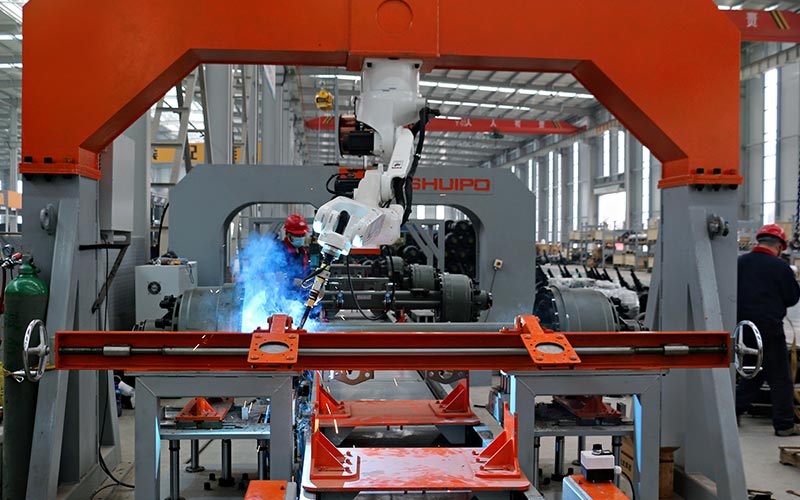
A welding robot is not just a robotic arm with a welding torch. It is a complete automation system that may include the robot body, welding power source, torch, wire feeder, control cabinet, fixture, positioner, safety system, software, and sometimes 3D vision or seam tracking technology. When these parts are properly matched, robotic welding can help manufacturers improve welding stability, reduce process variation, and make production easier to manage.
However, choosing the right welding robot is not about selecting the most advanced model. It is about matching the robot system to your workpieces, welding process, factory layout, operator skill level, and long-term production goals.
ما هو روبوت اللحام؟
A welding robot is a programmable automation system designed to perform welding operations with controlled movement, repeatable positioning, and stable welding parameters. According to the general definition of لحام الروبوت, robotic welding uses mechanized programmable tools to automate the welding process.
In real manufacturing projects, a welding robot normally performs three major tasks. First, it moves the welding torch along a planned path. Second, it keeps key welding parameters stable, such as current, voltage, wire feeding, torch angle, and travel speed. Third, it repeats the same welding process across multiple parts with much less variation than manual operation.
For industrial buyers, the real value is not only automation. The real value is process control. If your weld seam, fixture, workpiece accuracy, and programming method are well prepared, a welding robot can help turn a difficult manual process into a stable production workflow.
لماذا يستثمر المصنعون الصناعيون في روبوتات اللحام
Many factories do not consider robotic welding because it looks “high-end.” They consider it because their welding department is facing practical problems.
Common reasons include unstable weld bead appearance, high dependence on skilled welders, inconsistent production output, rework caused by welding defects, difficulty managing long seams, and limited capacity during peak orders. A welding robot can address these issues by making the welding path, welding speed, torch posture, and process parameters more repeatable.
Another important reason is production scalability. When orders increase, manual welding often depends on adding more operators and more workstations. Robotic welding allows manufacturers to build a more standardized process, so capacity can be improved through better cycle planning, multi-station layouts, positioners, and automation integration.
For companies producing steel structures, machinery parts, vehicle components, frames, tanks, containers, or similar welded assemblies, robotic welding is often not just a productivity tool. It becomes a way to control quality and reduce the uncertainty of production.
الأنواع الرئيسية لروبوتات اللحام المستخدمة في التصنيع
Different welding robots are designed for different production needs. Before you choose a system, you need to understand the main types and where they fit best.
| Welding Robot Type | Best For | Key Advantages | Selection Notes |
|---|---|---|---|
| روبوت لحام القوس | Steel structures, machinery frames, medium-to-heavy parts | Strong adaptability, widely used in industrial welding | Requires stable fixtures and suitable welding parameters |
| MIG/MAG welding robot | Carbon steel, structural parts, frames, containers | High efficiency and good continuous welding capability | Common choice for general metal fabrication |
| TIG welding robot | Stainless steel, thin materials, precision parts | Clean weld appearance and better control for delicate work | Usually slower than MIG/MAG welding |
| روبوت اللحام البقعي | Sheet metal assembly and overlapping joints | Fast cycle time and repeatable weld spots | Mainly suitable for specific joint designs |
| روبوت اللحام التعاوني | Small workshops, flexible production, medium-size workpieces | Easier deployment and human-robot collaboration | Suitable when flexibility is more important than extreme speed |
| روبوت اللحام الموجه بالرؤية | Complex parts, variable seams, high-mix production | Can support seam recognition and adaptive path planning | Requires stronger system integration capability |
A common mistake is choosing only by robot appearance. Two robots may look similar, but their payload, reach, control system, programming method, welding package, and fixture design may be completely different.
التطبيقات الرئيسية لروبوتات اللحام في التصنيع الصناعي
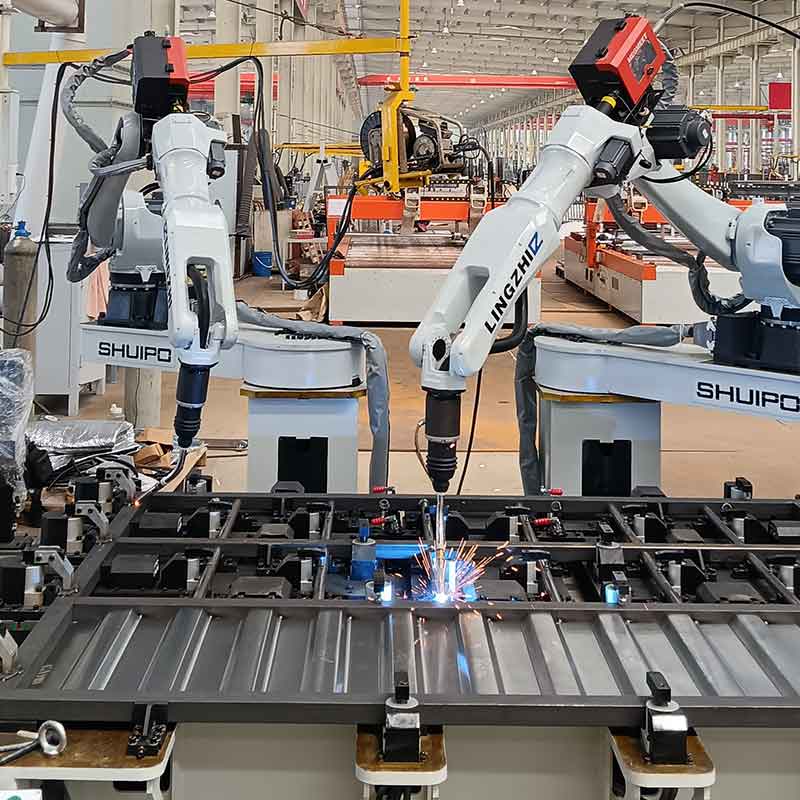
A welding robot is widely used in metal fabrication and industrial manufacturing where weld consistency, repeatability, and production efficiency are important.
Typical applications include machinery frames, steel structure components, vehicle bodies and subframes, storage tanks, pressure-related equipment, industrial pipelines, agricultural machinery parts, construction equipment parts, logistics equipment, energy storage containers, and customized metal assemblies.
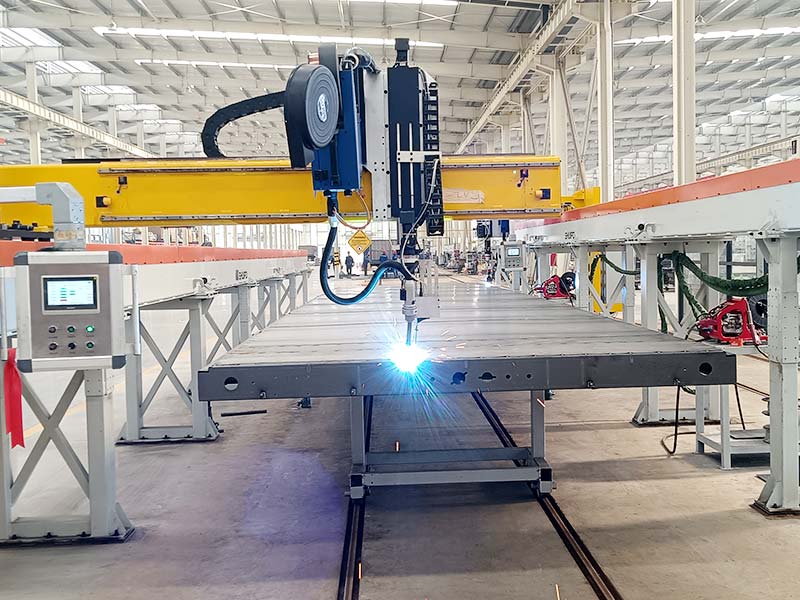
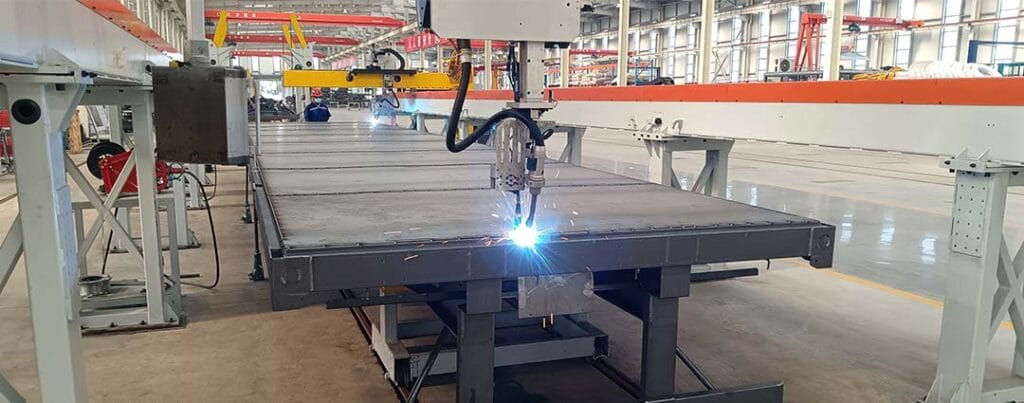
For these applications, the most suitable system is often not a single robot arm. It is a complete robotic welding workstation. The منتجات أتمتة اللحام used in manufacturing environments may include robotic welding workstations, automatic welding machines, intelligent production lines, and flexible automation systems.
The more complex the workpiece is, the more important the system design becomes. A long straight seam may only require basic path programming and reliable fixture positioning. A large irregular workpiece may require a positioner, laser positioning, 3D vision, adaptive seam tracking, or a teach-free welding workflow.
روبوت اللحام مقابل اللحام اليدوي: ما الذي يتغير حقًا؟
Manual welding depends heavily on the experience, physical condition, and skill level of the operator. A skilled welder can handle complex changes, judge welding conditions quickly, and adjust the torch angle by experience. This flexibility is valuable, especially for repair work, prototypes, and highly irregular parts.
A welding robot is different. It is strongest when the process can be standardized. Once the path, fixture, workpiece tolerance, and parameters are set correctly, the robot can repeat the same operation with high consistency.
The real change is not “robot replaces welder.” The better way to understand it is “robot standardizes repeatable welding, while people manage process planning, inspection, programming, and improvement.”
In a well-designed robotic welding project, experienced welders do not disappear from the process. Their role becomes more technical. They help define welding parameters, evaluate weld quality, optimize torch posture, improve fixtures, and solve process problems.
كيفية تقييم قطع العمل الخاصة بك قبل اختيار روبوت اللحام
The workpiece should always be the starting point. If you choose a welding robot before analyzing the workpiece, the final system may not match your real production needs.
Start with material type. Carbon steel, stainless steel, aluminum alloy, and other materials require different welding processes and parameter control. Then evaluate part size and weight. A large frame may need a long robot reach or external axis, while a compact part may work better in a smaller workstation.
Seam length is also important. Long continuous seams require stable travel speed, good wire feeding, suitable torch cooling, and reliable part positioning. Short intermittent seams may require more attention to cycle efficiency, start-stop control, and programming convenience.
Joint consistency is one of the most overlooked factors. A welding robot follows a programmed or detected path. If part dimensions vary too much, if gaps are inconsistent, or if the fixture cannot hold the part correctly, weld quality will still be unstable even with a good robot.
Batch size matters as well. For high-volume production, traditional teach-and-repeat robotic welding can be very efficient. For high-mix, low-volume production, a collaborative robot or vision-guided teach-free welding system may be more practical because setup time becomes a major factor.
العوامل الفنية الأساسية للمقارنة قبل الاختيار
When comparing welding robot systems, do not look only at the robot brand or arm structure. The key is whether the complete system can solve your welding problem.
Robot reach determines whether the torch can cover the full welding area. Payload affects whether the robot can carry the torch, cable package, and other end tools safely. Repeat positioning accuracy affects weld path consistency. The welding power source affects arc stability, penetration, spatter control, and process performance.
Fixture design is equally important. A weak fixture can ruin the performance of a strong robot. The fixture must position parts accurately, resist deformation, allow welding access, and support quick loading and unloading.
Programming method should match your production pattern. If you produce the same parts repeatedly, traditional programming can work well. If your products change often, graphical programming, drag-and-teach operation, offline programming, or vision-guided path generation may reduce setup pressure.
Seam tracking and vision systems are especially useful when parts have dimensional variation. A vision-guided system can help locate weld seams, correct path deviation, and improve adaptability. However, it should be selected based on real workpiece conditions, not simply added as a feature.
كيفية الاختيار بين روبوتات اللحام الصناعية وروبوتات اللحام التعاونية
Industrial welding robots are usually selected for higher-speed, high-volume, and more standardized production. They often work inside fenced cells and are suitable for factories that need strong output, stable cycle times, and multi-shift production.
Collaborative welding robots are often selected for flexible production, smaller workshops, or companies that need easier deployment and simpler operation. They can be useful when workpieces change frequently or when the factory does not want to build a large fixed robotic cell.
For example, a محطة عمل الروبوت التعاونية can support automated welding for steel structures, machinery parts, and complex-angle welding scenarios. This type of system is especially useful when manufacturers need a balance between welding automation and flexible operation.
The best choice depends on your production reality. If your factory needs maximum speed for stable high-volume parts, an industrial robot cell may be more suitable. If you need flexible welding for multiple product types, a collaborative or teach-free welding workstation may be a better fit.
ما الذي يجب تضمينه في نظام روبوت اللحام الكامل؟
A complete welding robot system should be designed as a production solution, not as separate equipment pieces.
A typical system may include the robot arm, controller, welding power source, wire feeder, welding torch, torch cleaning device, water cooling system, positioner, fixture, safety protection, electrical control cabinet, software interface, and operator training.
For more advanced applications, the system may also include 3D vision, laser seam tracking, offline programming, digital simulation, adaptive parameter control, and production data monitoring.
The most important question is whether all parts can work together smoothly. A robot with high accuracy will not deliver good welds if the power source is poorly matched. A strong welding process will not be stable if fixtures are inaccurate. A good workstation will still create problems if operators cannot use the interface efficiently.
That is why system integration experience matters. The supplier should understand welding technology, mechanical design, electrical control, automation layout, and on-site commissioning.
الأخطاء الشائعة التي يجب تجنبها عند شراء روبوت اللحام
One common mistake is focusing only on the robot arm. The robot arm is important, but weld quality depends on the entire system. The welding power source, torch, fixture, positioner, programming method, and process parameters are just as important.
Another mistake is ignoring workpiece tolerance. If part consistency is poor, the robot may need seam tracking, better fixtures, or improved upstream processing. Otherwise, the robot will repeat the same path while the real seam position changes.
A third mistake is choosing automation without considering operators. Even an advanced welding robot needs trained people for loading, inspection, parameter adjustment, maintenance, and troubleshooting. A user-friendly system can reduce training pressure and improve daily operation.
Some buyers also underestimate trial welding. Before final selection, sample testing is highly valuable. It helps verify weld appearance, penetration, cycle time, fixture feasibility, programming difficulty, and process stability.
How to Prepare Your Factory for Robotic Welding
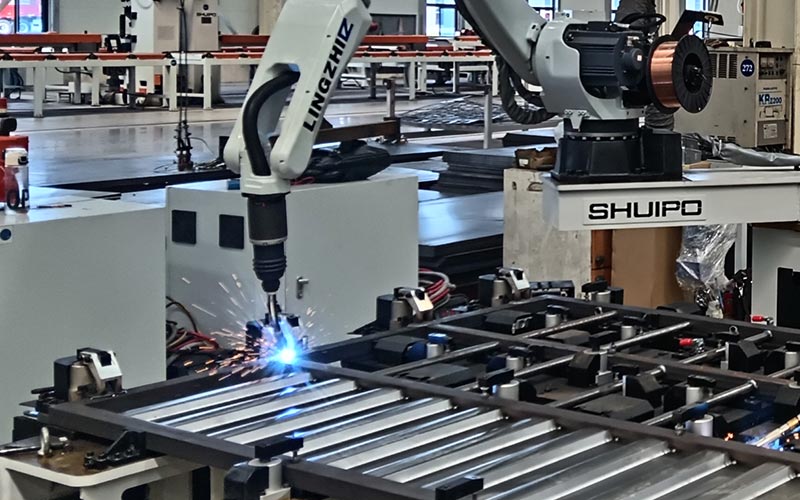
Before installing a welding robot, the factory should prepare both the process and the site.
Start by collecting workpiece drawings, material information, welding requirements, weld length, joint type, and expected output. Then review the consistency of part dimensions. If cutting, bending, machining, or assembly tolerance is unstable, upstream improvements may be needed before robotic welding can perform well.
The site should also be checked. Space, power supply, gas supply, grounding, ventilation, material flow, loading method, and safety layout all affect the final workstation design.
It is also useful to define the role of each operator. Who loads the parts? Who changes fixtures? Who adjusts the program? Who checks weld quality? Who performs daily maintenance? Clear responsibility makes robotic welding easier to manage after installation.
A welding robot is not a plug-and-play shortcut for every welding problem. It is a process upgrade. The better your preparation, the better the final result.
خاتمة
Choosing the right welding robot for industrial manufacturing requires more than comparing equipment specifications. You need to understand your workpieces, welding process, production volume, fixture accuracy, operator skill level, and long-term automation goals.
A good welding robot system should improve consistency, reduce process variation, support stable production, and make welding quality easier to control. The best solution is not always the most complex system. It is the one that fits your real production conditions.
If your factory handles repeatable welded components, long seams, complex metal structures, or multi-batch industrial products, robotic welding can become a strong step toward smarter and more reliable manufacturing.
الأسئلة الشائعة
What is a welding robot?
A welding robot is an automated system that uses a programmable robot arm, welding torch, controller, and welding power source to perform welding tasks. It helps improve repeatability, reduce manual variation, and make production quality easier to manage.
What industries commonly use welding robots?
Welding robots are widely used in metal fabrication, machinery manufacturing, vehicle components, steel structures, storage equipment, industrial frames, and heavy-duty welded assemblies where stable weld quality and repeatable production are important.
How do I choose the right welding robot?
Start with your workpiece size, material, seam length, joint consistency, batch size, and welding process. Then compare robot reach, payload, accuracy, programming method, fixture design, power source compatibility, and service support.
Is a collaborative welding robot suitable for industrial use?
Yes, a collaborative welding robot can be suitable for industrial use when flexibility, easier operation, and smaller workstation layouts are important. It is especially useful for medium-size parts, changing products, and high-mix production.
Why is fixture design important for a welding robot?
Fixture design directly affects part positioning and weld consistency. If the fixture cannot hold parts accurately, the robot may follow the programmed path correctly but still miss the real seam position or create unstable welding results.