
Оглавление
Введение
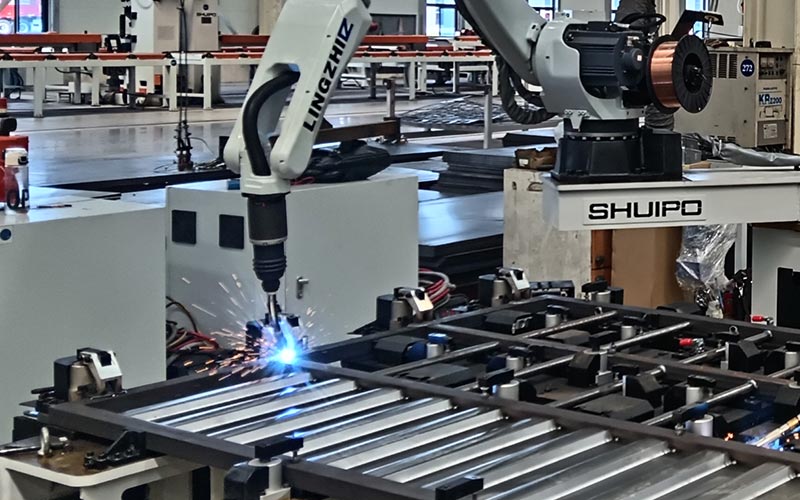
A spot welding robot is no longer evaluated only by how quickly it can move from one weld point to the next. Modern production places greater emphasis on force control, weld repeatability, part recognition, process monitoring, flexible programming, equipment condition, and the ability to adapt when components or production requirements change.
This shift is particularly important for sheet-metal assemblies and other applications containing large numbers of repeated spot welds. A robot may need to perform hundreds of precisely located welds while maintaining stable electrode alignment and following a tightly coordinated production sequence. Small variations in fixture position, electrode condition, sheet fit-up, or workpiece presentation can influence the overall process.
As a result, the development of the spot welding robot is moving from simple point-to-point automation toward a more connected and measurable manufacturing system. Servo-controlled welding guns, sensors, digital monitoring, predictive maintenance, vision systems, and flexible robot programming are becoming increasingly important parts of that system.
This article examines the trends shaping modern robotic spot welding and explains what they mean for manufacturers evaluating more flexible, repeatable welding automation.
What Is a Spot Welding Robot?
A spot welding robot is an industrial robotic system configured to perform resistance spot welding at programmed locations on a workpiece.
In spot welding, two electrodes apply force to overlapping materials while electrical resistance generates heat at the contact area. Unlike arc welding, the process does not require the robot to follow a continuous weld seam. Instead, the robot repeatedly positions the welding gun at individual weld locations.
A typical robotic cycle may involve:
- Moving the welding gun to the programmed location.
- Aligning the electrodes with the workpiece.
- Closing the welding gun.
- Applying the required electrode force.
- Executing the welding cycle.
- Opening the gun.
- Moving to the next weld point.
This sequence can be repeated many times across a single assembly.
Because the robot performs a large number of individual operations, small improvements in path planning, gun movement, electrode control, and production coordination can have a significant effect on the complete manufacturing cycle.
How Spot Welding Robots Differ From Arc Welding Robots
Spot welding and arc welding are both suitable for robotic automation, but the robot performs very different tasks.
An arc welding robot generally follows a seam continuously while maintaining torch orientation and travel speed. A spot welding robot moves between individual locations and repeatedly positions a welding gun against the workpiece.
| Фактор | Spot Welding Robot | Robotic Arc Welding |
|---|---|---|
| Welding pattern | Individual weld points | Continuous or segmented seams |
| Robot movement | Point-to-point positioning | Continuous path following |
| Welding tool | Resistance welding gun | Сварочный факел |
| Tool load | Welding gun can be relatively heavy | Torch assembly is generally lighter |
| Key positioning requirement | Accurate electrode placement | Accurate torch-to-seam relationship |
| Main cycle concern | Moving efficiently between weld points | Maintaining stable travel along the seam |
| Typical sensing need | Part position, gun force, weld monitoring | Seam location and path correction |
| Tool condition | Electrode condition is critical | Torch, wire and consumable condition are critical |
Understanding this difference is essential because the same robot selection logic should not automatically be applied to every welding process.
Trend 1: Servo-Controlled Welding Guns
One of the most important developments in robotic spot welding is increased use of servo-controlled welding guns.
Traditional pneumatic systems use compressed air to control electrode movement and force. Servo-controlled systems use an electric motor to provide more programmable control over gun opening, closing, position, and force.
For a spot welding robot, this can improve several aspects of the process.
The welding gun can approach the workpiece with controlled movement rather than relying only on fixed mechanical action. Electrode force can be managed more precisely, and different workpieces or material combinations can use different programmed settings.
Servo control can also support smoother integration with robot motion.
Instead of treating the welding gun as a simple open-or-close tool, the controller can coordinate gun movement with the robot’s position and the requirements of each welding point.
This creates more opportunities for process optimization when one robotic cell handles multiple assemblies.
Trend 2: Smarter Robot Path Planning
A spot welding robot may need to reach a large number of weld points on one component.
The order in which those points are visited has a direct effect on robot movement.
An inefficient program may cause the robot to travel repeatedly across the workpiece, rotate through unnecessary wrist movements, or enter awkward configurations.
Modern path planning increasingly focuses on finding a more efficient sequence between welding points.
The objective is not simply to minimize physical distance.
Engineers also need to consider:
- robot joint movement
- welding gun orientation
- помехи приспособления
- маршрутизация кабелей
- workpiece geometry
- accessibility
- robot singularities
- shared robot workspaces
A slightly longer geometric path may sometimes be preferable if it allows smoother robot motion and avoids extreme wrist rotation.
For assemblies containing many weld points, path optimization can therefore become an important part of complete cell performance.
Trend 3: Greater Use of Vision and Part Recognition
Traditional robotic spot welding works extremely well when the component always appears in the same position.
Real production can contain variation.
A part may shift slightly during loading. Fixture tolerances can change the actual component position. Different product variants may also enter the same workcell.
Vision systems can provide the robot with information about the real workpiece before the welding sequence begins.
Depending on the application, vision may help identify:
- присутствие заготовки
- component orientation
- product variant
- locating features
- fixture position
- assembly alignment
This does not mean that vision eliminates the need for fixtures.
A better approach is to use mechanical locating features to control the workpiece as much as practical, then use sensing when additional information about part position is required.
The underlying principle is similar across many роботизированные сварочные системы: repeatable robot motion becomes more useful when the automation system also understands where the real component is located.
Trend 4: Adaptive Weld Parameter Control
A conventional spot welding robot executes predefined welding conditions at each programmed location.
More advanced systems can also monitor process variables and use that information to determine whether welding conditions remain within acceptable limits.
Spot welding performance can be influenced by variables such as:
- material condition
- sheet thickness
- electrode condition
- electrode force
- electrical resistance
- surface contact
- fit-up
Rather than treating every welding point as identical regardless of process behavior, adaptive control creates the possibility of responding to measured conditions within validated operating limits.
This represents an important change in welding automation.
The traditional model is:
program the operation and repeat it.
The emerging model is:
program the operation, measure the process, and verify that the welding conditions remain inside the intended operating window.
The robot still follows an engineered welding procedure, but the system gains more information about what is happening during production.
Trend 5: Real-Time Weld Monitoring
Spot welding robots generate repeated process events, making them well suited to structured monitoring.
Instead of inspecting only the final assembly, production systems can record information associated with individual welding cycles.
Depending on the equipment, monitored information can include operating status, electrode movement, welding cycle completion, process signals, alarms, and other production variables.
The value of this information comes from context.
Collecting thousands of data points has limited benefit if nobody knows which information indicates a meaningful process change.
A practical monitoring strategy begins by asking:
What conditions indicate that the process is moving away from normal operation?
Once those conditions are defined, the data can support earlier investigation.
For example, gradual changes across repeated welding cycles may indicate electrode wear or another developing condition before the process causes repeated production problems.
This shifts monitoring from simple record keeping toward process management.
Trend 6: Electrode Condition Monitoring
Electrodes directly contact the workpiece during spot welding, so their condition can influence the process over time.
Repeated welding cycles can gradually change the electrode tip.
As the contact surface changes, the relationship between electrode force, current flow, and the workpiece can also change.
Traditional maintenance may rely heavily on predefined intervals.
A more data-driven approach combines production counts and process behavior to determine when electrode servicing or dressing should occur.
This is particularly useful in high-cycle robotic spot welding because electrode condition changes gradually rather than suddenly.
Monitoring can help identify the difference between:
normal process variation
and
a developing equipment condition.
The goal is not to eliminate scheduled maintenance completely. It is to support maintenance decisions with better information about the actual operating condition of the welding equipment.
Trend 7: Predictive Maintenance for Robotic Welding Cells
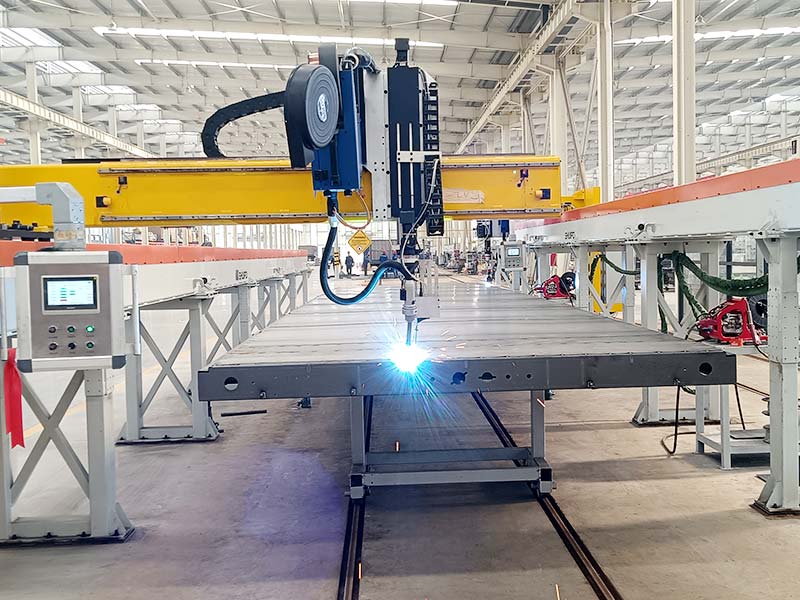
A spot welding robot depends on much more than the robotic arm.
The complete cell may include:
- welding guns
- servo motors
- controllers
- fixtures
- electrodes
- cables
- transformers
- cooling systems
- safety equipment
- material-handling devices
Any recurring issue within these components can interrupt production.
Predictive maintenance uses operating information to identify patterns that may indicate abnormal behavior before a failure becomes obvious.
For example, engineers may monitor changes in:
- servo behavior
- cycle timing
- gun movement
- equipment temperature
- repeated alarms
- electrode condition
- robot axis behavior
The important word is pattern.
A single unusual reading may not mean much. Repeated changes over time can provide more useful information.
This creates a different maintenance philosophy: instead of reacting only after production stops, the system can provide earlier evidence that something requires attention.
Trend 8: More Flexible Spot Welding Cells
Robotic spot welding has historically been strongly associated with highly repetitive production.
That remains an important application, but manufacturers increasingly need automation that can accommodate several product variants.
Flexible fixtures, stored robot programs, part recognition, programmable welding guns, and digital production management can help one cell support multiple assemblies.
This does not mean unlimited flexibility.
The products still need enough common structure for the automation system to handle them efficiently.
A flexible family of components might share:
- common locating points
- similar material arrangements
- related weld patterns
- overlapping robot workspace
- compatible fixture architecture
The goal is to identify these common characteristics and design the cell around them.
This approach allows the spot welding robot to remain productive even when manufacturing requirements change more frequently.
Trend 9: Digital Simulation Before Installation
Modern robotic welding projects increasingly use simulation before physical cell installation.
This is particularly valuable for spot welding because the welding gun can be large and the robot may need to reach many positions inside a complex fixture.
Digital simulation can help engineers evaluate:
- robot reach
- gun orientation
- помехи приспособления
- зазор кабеля
- robot joint limits
- collision risks
- weld-point sequence
- cycle structure
This reduces the risk of discovering major accessibility problems after the physical equipment has already been installed.
Simulation is also useful when comparing different cell layouts.
A robot positioned slightly differently may gain better access to several weld points or reduce difficult wrist configurations.
These changes can be difficult to predict from a two-dimensional layout alone.
Simulation therefore becomes an engineering tool for validating the relationship between the robot, welding gun, workpiece, and fixture.
Trend 10: Digital Twins and Virtual Commissioning
Simulation primarily asks whether a proposed system can work.
Digital-twin concepts extend this idea by connecting a digital representation more closely with the actual production system.
For spot welding automation, a digital model can contain information about:
- robot configuration
- workcell geometry
- weld-point locations
- fixture positions
- производственная последовательность
- motion paths
Virtual commissioning can then allow parts of the control strategy to be tested before full physical operation begins.
The potential benefit is fewer surprises during installation and commissioning.
For complex robotic cells containing multiple robots, fixtures, transfer equipment, and many welding points, identifying logic problems digitally can reduce unnecessary adjustments on the production floor.
However, digital models still need accurate real-world information.
A perfect virtual workpiece cannot compensate for uncontrolled physical variation after the system enters production.
Trend 11: Multi-Robot Spot Welding
Large assemblies can contain many welding points distributed across different areas of the workpiece.
Using one robot for every weld may create an unnecessary cycle limitation.
Multi-robot systems divide the operation between several robots.
For example, one robot may work on one side of the assembly while another handles a separate zone.
This can reduce unnecessary travel and allow operations to occur in parallel.
The challenge is coordination.
Robots working in nearby areas must avoid collisions and shared-space conflicts.
Cell design needs to consider:
- individual working zones
- overlap areas
- последовательность сварки
- доступ к светильнику
- robot synchronization
- workpiece transfer
- maintenance access
Adding more robots should therefore be based on process balance rather than equipment quantity.
The strongest multi-robot layouts give each robot a clearly defined workload while minimizing interference between them.
Trend 12: More Attention to Robot Payload and Gun Geometry
Spot welding guns can place substantial mechanical demands on a robot.
The gun itself, transformer configuration, cables, sensors, and related tooling all contribute to the tool load.
Payload selection should therefore consider more than total weight.
The center of gravity and wrist moment also influence how the robot behaves.
A large welding gun mounted far from the robot wrist creates a different mechanical condition from a compact tool with the same mass.
Gun geometry also affects accessibility.
A robot may have sufficient reach while the welding gun itself cannot enter the required area without hitting the fixture or surrounding component.
Robot selection should therefore be based on the actual tool model and workpiece geometry rather than generic reach and payload numbers.
Trend 13: Better Integration With Automated Production Lines
A spot welding robot rarely operates completely independently in large automated production environments.
The robotic cell may be connected to:
- component transfer
- automated loading
- fixture indexing
- product identification
- инспекционные станции
- линейные контроллеры
- downstream assembly
This makes station balance increasingly important.
A robot that completes welding quickly provides limited benefit if it spends much of its operating cycle waiting for another process.
Engineers should therefore evaluate the complete production sequence.
If one station repeatedly becomes the bottleneck, improving welding robot speed elsewhere may simply create more waiting.
The objective is a coordinated production rhythm rather than maximum individual machine speed.
Trend 14: Greater Production Traceability
As robotic production becomes more connected, manufacturers are increasingly able to associate process information with individual production cycles.
For spot welding, this can mean recording whether specific welding operations were completed and whether monitored process conditions remained within defined limits.
Traceability can support several manufacturing activities:
- production verification
- process analysis
- устранение неполадок
- equipment maintenance
- quality investigation
- continuous improvement
The practical value becomes clear when a problem appears later.
Instead of asking only whether the robot was operating, engineers can examine how the relevant production sequence behaved.
This makes process data more useful as part of manufacturing engineering rather than simply an archive.
Trend 15: Spot Welding Robot Cells Designed for Easier Changeover
Production flexibility is not determined only by robot programming.
Fixtures can create an equally significant limitation.
If changing from one assembly to another requires extensive mechanical adjustment, fast robot program switching provides only part of the solution.
Modern flexible workcells increasingly consider changeover at the system level.
This can involve:
- modular locating features
- interchangeable fixture components
- stored robot programs
- automatic part identification
- programmable welding gun settings
- structured product-family design
The objective is to reduce the number of manual decisions and adjustments required when production changes.
For manufacturers handling several related assemblies, this can make the difference between theoretical flexibility and practical flexibility.
What Has Not Changed in Spot Welding Automation
New technologies can make a spot welding robot more capable, but several fundamental requirements remain unchanged.
The workpiece still needs to be presented in a controlled way.
Fixtures still need to maintain appropriate alignment.
The welding gun still needs physical access to the required points.
Robot reach and payload still matter.
Electrode condition still needs attention.
Safety still needs to be engineered around the complete application.
This is important because advanced technology can sometimes distract from basic production problems.
Vision cannot solve every fixture issue.
AI cannot make an inaccessible weld point accessible.
Process monitoring cannot compensate for an incorrectly selected welding gun.
The strongest automation projects use new technology to improve an already well-understood manufacturing process.
How to Evaluate a Spot Welding Robot Application
A useful evaluation starts with the real component.
First, map all required welding points.
Record their locations, orientations, surrounding geometry, and accessibility.
Then examine how the component will be located.
The robot can only position the electrodes accurately when the workpiece itself has a predictable relationship with the robotic coordinate system.
Next, evaluate welding gun access.
A tool may reach one weld point easily while another is blocked by the fixture or surrounding structure.
Robot movement between points should then be analyzed.
Unnecessary travel, wrist rotation, and repeated repositioning can reduce process efficiency.
Finally, examine the complete production sequence, including loading, clamping, welding, inspection, unloading, and product changeover.
This process-based evaluation usually reveals more useful information than comparing robot specifications alone.
Where Spot Welding Robot Technology Is Heading
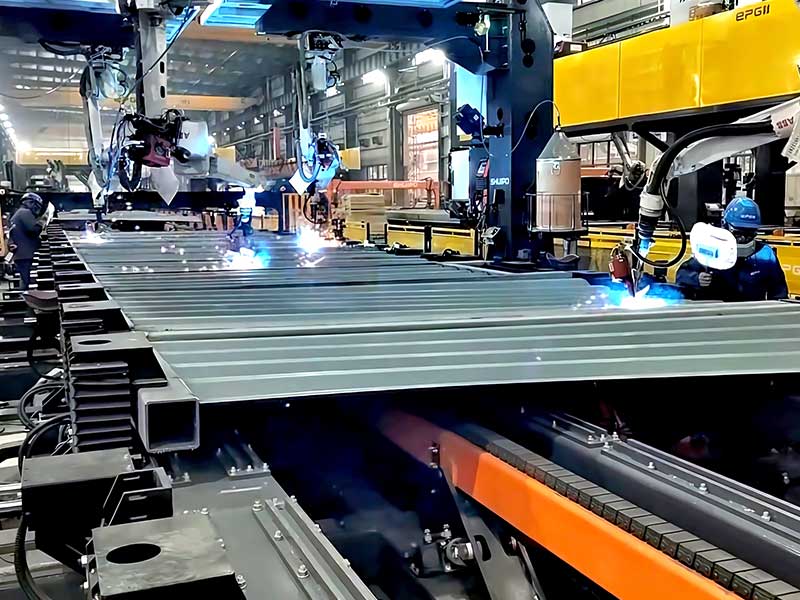
The future of robotic spot welding is increasingly connected with three ideas: visibility, adaptability, and connectivity.
Visibility means that the automation system collects more information about the workpiece, welding equipment, and process.
Adaptability means that validated control systems can respond to measured differences rather than relying completely on one fixed condition.
Connectivity means that welding data becomes part of the broader manufacturing environment, supporting maintenance, production analysis, traceability, and process improvement.
These developments do not eliminate the need for traditional welding engineering.
Instead, they give engineers better tools for understanding and controlling what happens inside a robotic welding cell.
The result is a spot welding robot that is increasingly managed as part of an intelligent production system rather than as an isolated point-to-point machine.
Заключение
The development of the spot welding robot is moving beyond basic repetitive automation.
Servo-controlled welding guns provide greater control over electrode movement. Vision systems improve part recognition. Process monitoring provides more information about individual welding cycles, while predictive maintenance helps engineers understand equipment behavior over time.
Digital simulation, flexible fixtures, multi-robot coordination, and better production-line integration are also changing how spot welding cells are designed.
Yet the fundamentals remain critical.
Workpiece positioning, fixture accuracy, gun access, robot payload, weld-point planning, electrode condition, and process stability still determine whether the system performs reliably.
For manufacturers evaluating modern spot welding automation, the strongest strategy is to combine these fundamentals with sensing, data, and flexible control only where they solve a clearly defined production requirement.
ЧАСТО ЗАДАВАЕМЫЕ ВОПРОСЫ
What is a spot welding robot?
A spot welding robot is an industrial robot configured to position a resistance welding gun at programmed weld points. The system repeatedly moves between locations, closes the electrodes, performs the welding cycle, and continues to the next point while maintaining controlled positioning and process conditions.
Why are servo welding guns important for spot welding robots?
Servo-controlled guns provide programmable control over electrode movement and force. They can support smoother gun operation, different settings for multiple workpieces, and closer coordination between the welding tool and robot motion than a basic fixed-action system.
Can a spot welding robot handle different products?
Yes, when products share enough compatible geometry and process requirements. Stored robot programs, flexible fixtures, part recognition, and programmable welding settings can support different assemblies, although each product still needs reliable positioning and welding-gun access.
How does vision improve a spot welding robot?
Vision can identify workpiece presence, position, orientation, or product variant before welding begins. This gives the robotic system more information about the actual component and can help manage controlled production variation instead of relying entirely on one fixed nominal position.
What should be checked before selecting a spot welding robot?
Evaluate weld-point locations, workpiece dimensions, gun geometry, robot reach, payload, fixture design, electrode access, production sequence, product variation, and changeover needs. The complete cell should be assessed with the real welding tool rather than using robot specifications alone.
Need Help Planning the Right Spot Welding Automation?
If your production requires repeated weld points, flexible product handling, complex gun access, or integration with a broader automated line, the robot should be selected as part of the complete process. A консультация по проекту автоматизации сварки can evaluate workpiece geometry, fixtures, robot reach, tool access, and production flow around your actual manufacturing requirements.