
Table of Contents
Introduction
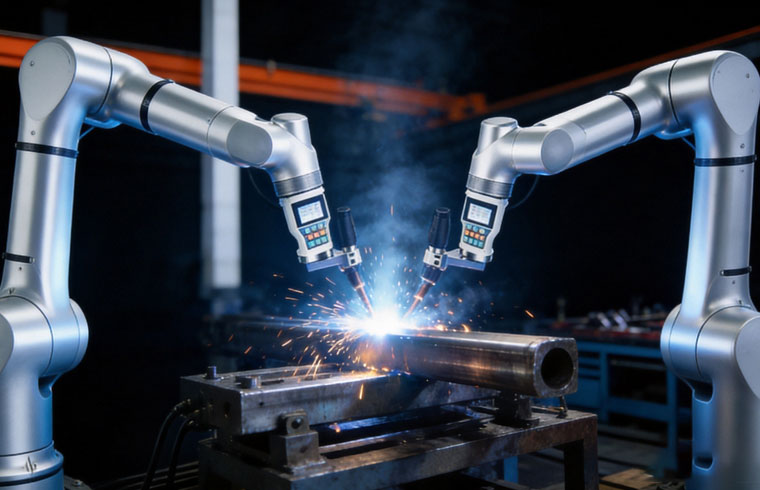
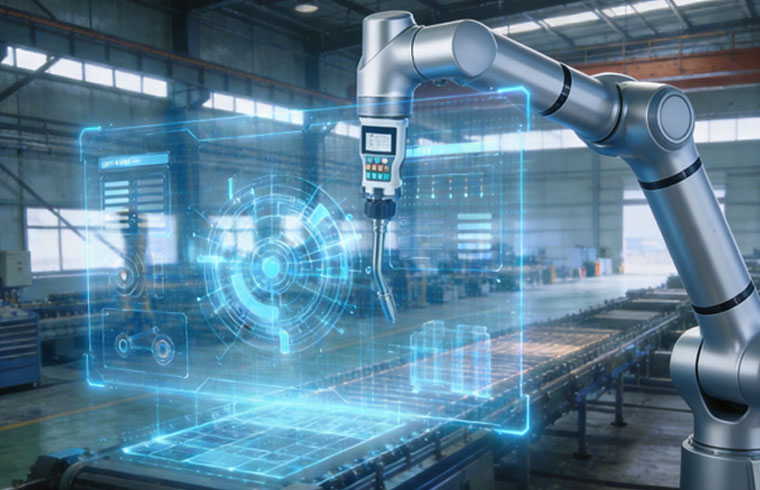
A cobot welding robot is changing how manufacturers think about welding automation. Traditional robotic welding cells are often associated with fixed production environments, dedicated guarding, highly repetitive parts, and relatively stable product runs. Collaborative welding systems are expanding that picture by making automation more accessible to operations that need flexibility, easier programming, and faster changeovers between different workpieces.
The value of a cobot welding robot does not come from simply making a robot smaller or easier to move. Its real value depends on how well the complete system handles welding paths, part variation, operator interaction, fixture requirements, sensing, safety, and changes in production.
This is especially important in high-mix manufacturing. A company may not weld the same component continuously for long periods. One shift may involve frames, another may involve brackets, and another may require a different joint configuration entirely. In that environment, the welding system must do more than repeat one fixed program.
This guide explains seven cobot welding robot features that have the greatest practical impact on real welding applications, along with the engineering considerations that determine whether collaborative welding is the right automation strategy for your production.
What Is a Cobot Welding Robot?
A cobot welding robot is a collaborative robotic system configured to perform welding operations while supporting closer interaction with operators than many conventional industrial robot installations.
The term cobot generally refers to a collaborative robot, but collaboration does not mean that every welding application can operate without guarding or safety controls. Welding introduces additional risks such as arc radiation, heat, fumes, electrical hazards, hot workpieces, and spatter. The final safety concept therefore depends on the complete application rather than the robot alone.
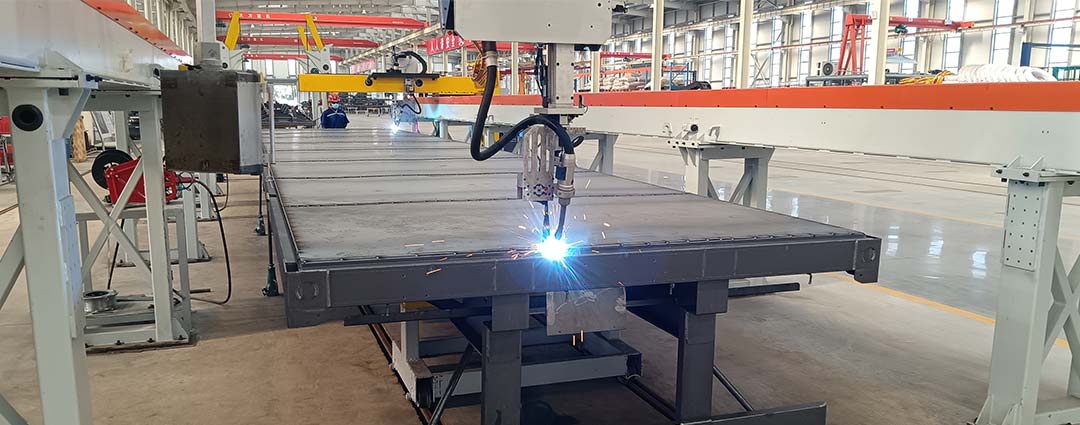
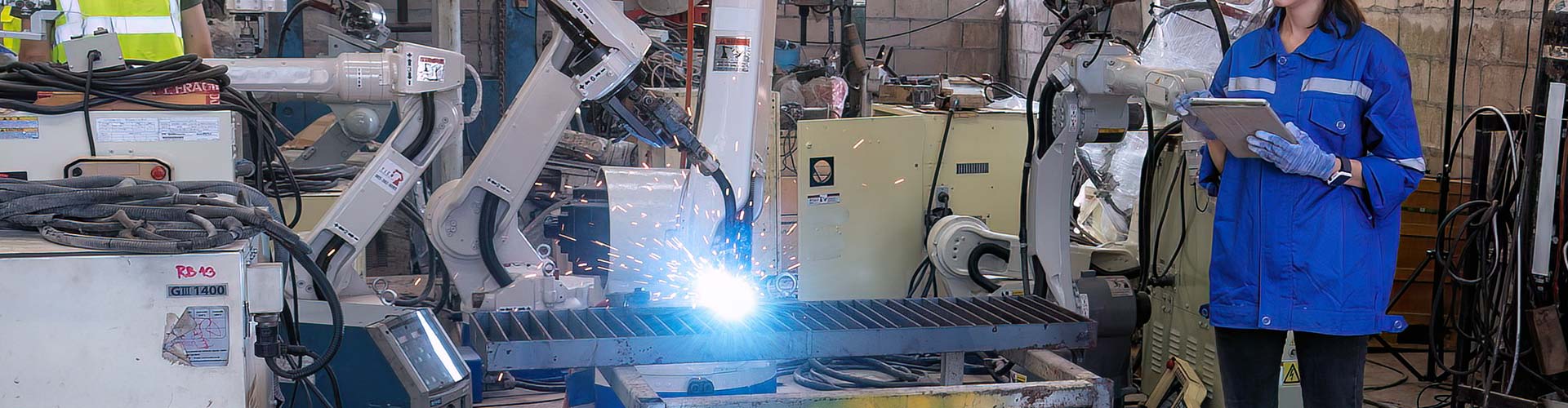
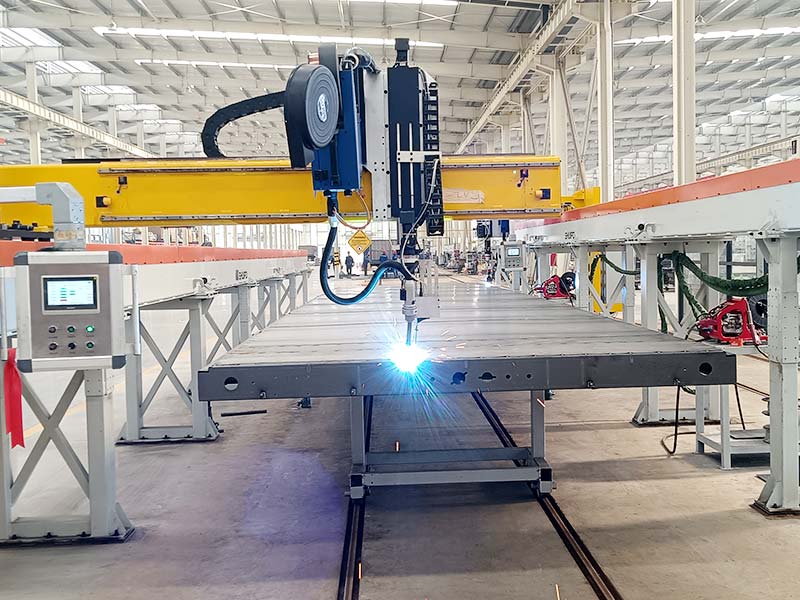
A typical cobot welding system can include the robotic arm, welding torch, power source, wire feeder, controller, worktable, fixture, sensing technology, and safety equipment.
The biggest difference from traditional fixed automation is often flexibility. Cobot systems are frequently designed to make programming, redeployment, and changeover easier when manufacturers need to handle multiple welding tasks rather than a single high-volume component.
1. Easy Welding Path Programming
Programming is one of the most important features of a cobot welding robot because it directly affects whether automation remains practical when products change.
Traditional industrial robot programming may require extensive point teaching, specialist programming knowledge, or offline programming tools. Collaborative welding systems increasingly use simplified interfaces that allow operators to define weld locations, approach points, torch orientations, and welding sequences with less programming complexity.
This becomes valuable when a production facility handles several workpiece families.
If programming a new part requires a long engineering process, automation can lose some of its advantage in short production runs. If the system allows welding paths to be created, adjusted, and stored efficiently, the same robot can be used across a wider range of components.
However, easy programming should not be confused with automatic welding engineering.
The operator still needs to understand joint geometry, torch angle, travel direction, weld access, process parameters, and collision risks. Simplified programming reduces the effort required to communicate a welding path to the robot, but it does not remove the need for sound process knowledge.
2. Flexible Changeover Between Workpieces
High-mix production is one of the strongest reasons manufacturers evaluate cobot welding.
A conventional welding cell can provide excellent productivity when one product remains stable for long production runs. But when components change frequently, fixture changes and reprogramming can become a major part of the overall cycle.
A cobot welding robot is often more useful when the production system is designed around flexible changeover.
That flexibility may come from modular fixtures, reusable robot programs, adjustable worktables, stored welding procedures, or vision-based part identification.
The important question is not simply whether the robot can weld different products.
A better question is:
How quickly can the entire system move from one product to another without sacrificing welding consistency?
For example, if changing a workpiece requires rebuilding the fixture, redefining every robot point, and manually adjusting torch orientation, the system may technically be flexible but operationally inefficient.
A well-designed cobot welding system should reduce those changeover steps wherever practical.
3. Compact Workcell Integration
A cobot welding robot is often selected because it can fit into production environments where space is limited or where a large dedicated robotic cell would be difficult to integrate.
Compact integration can provide several operational benefits.
The robot may be mounted on a welding table, mobile base, modular workstation, or other production platform. This can allow automation to be positioned closer to existing fabrication processes without completely reorganizing the facility.
But compact design requires careful engineering.
The robot still needs sufficient working space to maintain torch orientation and avoid collisions. Fixtures, workpieces, wire feeders, cables, extraction systems, and safety devices all require space around the welding operation.
A workcell should therefore be designed around the robot’s usable working envelope rather than simply its maximum reach.
A robot that can technically reach a weld may still have difficulty maintaining the required torch angle near the edge of its range.
This is why workspace simulation and representative workpiece testing are valuable before finalizing the layout.
4. Vision and Seam Sensing Capability
Part variation is one of the biggest challenges in robotic welding.
A robot can repeat its programmed movement very accurately, but welding quality depends on the actual position of the joint rather than the theoretical position stored in the program.
If components vary because of cutting, forming, assembly, tack welding, or fixture tolerances, the seam may not appear in exactly the same location every cycle.
Vision and seam sensing can help address this problem.
Depending on the system, sensors can identify the workpiece, locate a weld seam, determine joint position, or provide information that allows the robot to adjust its path.
This is becoming especially relevant for cobot welding because many collaborative systems are used in high-mix environments where variation is more common than in dedicated mass-production cells.
The principle is straightforward:
the robot provides repeatable movement, while the sensor provides information about the real part.
These capabilities can also support more advanced teach-free or semi-automatic programming strategies. SHUIPO’s robotic welding systems and automation equipment combine robotic motion with technologies such as sensing, positioning, and intelligent welding functions for different industrial applications.
5. Consistent Torch Motion and Welding Parameters
A major reason to automate welding is repeatability.
In manual welding, an experienced welder constantly adjusts torch position, travel speed, working angle, and other variables based on visual and physical feedback. That adaptability is valuable, but results can vary between operators or over long production periods.
A cobot welding robot approaches the process differently.
Once the welding path and parameters have been validated, the robot can reproduce the same torch movement across repeated parts.
This does not automatically guarantee a perfect weld.
The system still depends on joint preparation, fixture accuracy, shielding conditions, wire feeding, welding parameters, and part consistency.
But when those variables are controlled, robotic motion can reduce variation in:
- travel speed
- torch orientation
- weld start and stop position
- movement between seams
- welding sequence
This repeatability becomes particularly useful when the same joint appears across several workpieces or when visual consistency is important.
6. Integration With Positioners and Welding Fixtures
The robot arm is only one part of a cobot welding system.
Many workpieces contain seams that cannot be accessed effectively from one fixed orientation. A frame may contain joints on several sides. A cylindrical component may require circumferential welding. A larger fabrication may include welds that force the robot into difficult wrist positions.
Positioners can solve part of this problem by moving the workpiece into a better welding orientation.
A rotary table, turning device, or other external axis can present the joint to the robot instead of forcing the robot to reach every seam from a fixed location.
This can improve:
- torch access
- robot working posture
- welding orientation
- path stability
- collision clearance
Fixtures are equally important.
A collaborative robot may be easy to program, but the welding path still assumes that the workpiece appears in a predictable location. If the fixture allows the component to shift between cycles, the robot may follow the correct programmed path while missing the actual seam.
This is why cobot welding should be treated as a workcell engineering project rather than simply a robot purchase.
7. Adaptability for High-Mix, Low-Volume Welding
One of the most important trends in welding automation is the growing demand for automation that can handle more product variation.
Manufacturers do not always produce thousands of identical components. Many operations work with multiple product families, smaller batches, customized structures, and frequent engineering changes.
This is where the cobot welding robot can be especially useful.
The strongest high-mix applications usually combine several capabilities:
| Feature | Contribution to High-Mix Welding |
|---|---|
| Simplified programming | Reduces setup effort for new weld paths |
| Stored programs | Allows repeated products to return quickly to production |
| Flexible fixtures | Supports different workpiece families |
| Vision sensing | Helps locate changing joint positions |
| Seam tracking | Manages controlled welding path variation |
| Positioners | Expands access to different part geometries |
| Modular workcells | Allows the automation system to adapt to new production tasks |
The key word is controlled variation.
A cobot does not automatically make completely unpredictable workpieces easy to automate. The more variation that can be structured, measured, and detected, the more useful collaborative welding becomes.
Cobot Welding Robot vs Traditional Industrial Welding Robot
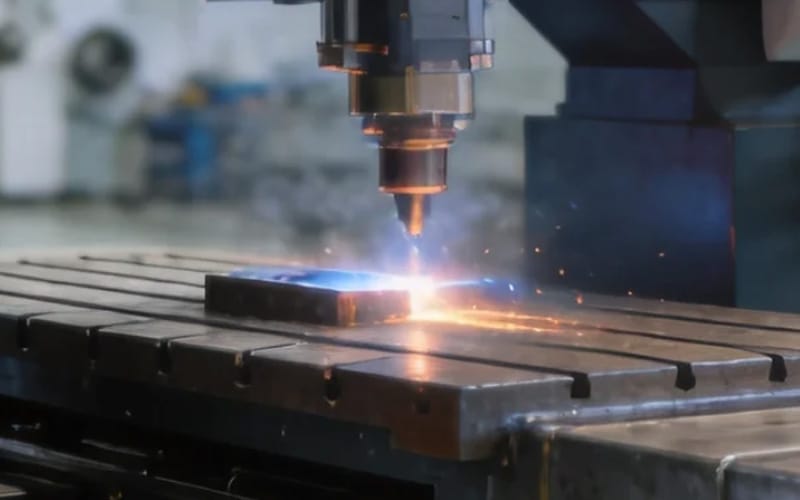
Both collaborative and traditional robots can perform welding successfully, but they are often optimized for different production environments.
| Consideration | Cobot Welding Robot | Traditional Industrial Welding Robot |
|---|---|---|
| Typical programming approach | Often simplified and operator-friendly | Often specialist or engineering-led |
| Changeover flexibility | Strong for changing product families | Strongest in stable repetitive production |
| Workcell size | Often relatively compact | Can require larger dedicated cells |
| Typical speed emphasis | Balanced with collaborative design | Often optimized for high production speed |
| Redeployment | Generally easier | Usually more fixed |
| High-volume production | Suitable in some applications | Often highly effective |
| High-mix production | Particularly attractive | Possible with appropriate engineering |
| Safety assessment | Required for the full welding application | Required for the full robotic cell |
The decision should therefore not be based on the assumption that one robot category is universally better.
A traditional industrial robot may be the stronger choice for a highly repetitive process requiring maximum production speed and a permanent automated cell.
A cobot welding robot may be more appropriate when flexibility, smaller production batches, frequent product changes, and simplified programming are higher priorities.
Why Safety Still Requires Application-Level Engineering
The word collaborative can create a misleading impression that the robot can always operate freely beside people.
Welding makes the safety assessment more complex.
Even if the robot itself includes force limiting, monitored motion, safe speed functions, or other collaborative capabilities, the welding process can create hazards independent of robot movement.
These can include:
- arc radiation
- heat
- welding fumes
- hot workpieces
- electrical hazards
- spatter
- wire movement
- torch components
For this reason, a cobot welding robot may still require screens, enclosures, extraction equipment, interlocks, scanners, or other protective measures depending on the application.
A good safety design evaluates the complete workcell.
It considers how operators load the workpiece, when welding can start, where people may enter the workspace, how the robot behaves during setup, and what happens during abnormal conditions.
Safety should therefore be integrated into the process design from the beginning.
How Cobot Welding Supports Better Use of Skilled Welders
Cobot welding is sometimes described as replacing manual welding, but this is usually too simplistic.
A more useful way to understand the technology is to look at how skilled welding knowledge is used.
A repetitive weld that occurs hundreds of times does not necessarily require a skilled operator to hold the torch for every cycle. Automation can perform the repeated movement while experienced personnel focus on higher-value activities such as:
- welding process development
- parameter validation
- quality inspection
- fixture improvement
- difficult manual welds
- new product introduction
- troubleshooting
This approach can help manufacturers use skilled welding expertise more effectively.
The robot handles repetition.
The welding professional handles judgment.
That division becomes especially valuable when production contains both stable repetitive joints and specialized work that is difficult to automate.
Common Mistakes When Choosing a Cobot Welding Robot
One mistake is selecting the robot based only on payload and reach.
The welding application should determine the robot configuration, not the other way around.
Another mistake is underestimating fixture requirements.
Even a highly flexible robot needs a repeatable reference between the programmed path and the real workpiece.
Another common issue is ignoring cable routing and torch geometry.
A robot may reach a seam while welding cables or the torch body interfere with the fixture or workpiece.
Manufacturers should also avoid assuming that easier programming means every product is automatically suitable for robotic welding.
Joint accessibility, fit-up, part consistency, welding process stability, and production flow still matter.
Finally, a cobot should not be selected solely because the workcell appears simpler.
The complete system should be evaluated against the required welding process and long-term production strategy.
How to Evaluate Whether a Cobot Welding Robot Fits Your Production
Start by identifying your repeated welding tasks.
Which components return regularly? Which seams have similar geometry? Which welds take significant operator time? Where does weld consistency matter most?
Next, examine variation.
Measure how much the real parts differ from one another. Look at joint location, gap, distortion, tack position, and fixture loading.
Then evaluate accessibility.
Determine whether the torch can reach every joint with a practical working angle. Consider whether a positioner would improve access.
Programming frequency is another important factor.
If product variants change regularly, consider how quickly new paths can be created and how easily stored programs can be recalled.
Finally, examine the complete production cycle.
Loading, clamping, welding, repositioning, inspection, and unloading all affect whether the automation system improves the process.
A strong cobot welding project solves a manufacturing problem rather than simply adding a robot.
How Cobot Welding Is Evolving
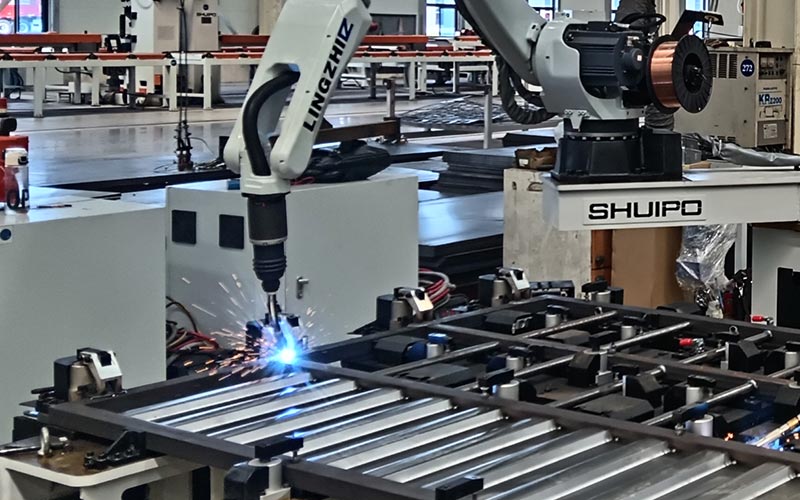
The most important development in cobot welding is not simply improved robot hardware.
The larger change is the combination of collaborative robots with vision, seam tracking, offline programming, digital workpiece data, and increasingly adaptive welding functions.
These technologies are making it easier to apply welding automation to production environments where product variation once made fixed robotic programming difficult.
In practical terms, the future of the cobot welding robot is moving toward systems that require less manual point teaching and have a better understanding of the actual workpiece.
That does not eliminate welding engineering.
Instead, it shifts more attention toward defining acceptable process variation, building stable fixtures, validating welding procedures, and giving the robotic system reliable information about the part.
For high-mix manufacturing, that combination of flexibility and process control is likely to remain one of the most important directions in welding automation.
Conclusion
A cobot welding robot can provide much more than automated torch movement.
Its strongest features include simplified programming, flexible changeover, compact integration, sensing capability, repeatable motion, positioner compatibility, and adaptability for high-mix production.
However, the robot alone does not determine whether the project succeeds.
Workpiece repeatability, joint accessibility, fixture design, welding parameters, sensing requirements, safety, and overall production flow all influence the result.
The best collaborative welding systems are designed around real workpieces and real manufacturing variation.
If your production includes repeated welding tasks but also requires frequent product changes, a cobot welding robot can provide a practical bridge between manual flexibility and fully dedicated robotic automation.
FAQ
What is a cobot welding robot?
A cobot welding robot is a collaborative robot configured for automated welding. It can combine simplified programming, repeatable torch motion, welding equipment, fixtures, sensing, and safety systems to support flexible production where workpieces or welding tasks may change regularly.
Is a cobot welding robot suitable for high-mix production?
Yes. Cobot welding is particularly useful when manufacturers handle multiple product variants. Stored programs, flexible fixtures, simplified teaching, vision, and seam tracking can reduce changeover effort, although workpiece variation still needs to remain measurable and controllable.
Can a cobot welding robot work without safety guarding?
Not automatically. Collaborative robot functions do not remove hazards created by welding, such as arc radiation, fumes, heat, spatter, and electrical risks. The complete application requires a safety assessment, and protective equipment may still be necessary.
What welding applications are best for cobot robots?
Cobot welding works well for repeated welds, smaller production batches, changing product families, and tasks where simplified programming is valuable. Suitability depends on part consistency, weld accessibility, fixture quality, process stability, and expected production variation.
What should I check before selecting a cobot welding robot?
Check workpiece dimensions, joint variation, torch access, fixture requirements, robot reach, welding process, programming frequency, positioner needs, safety requirements, and production flow. The best robot configuration should follow process analysis rather than equipment selection alone.
Need Help Choosing the Right Cobot Welding Robot?
If you’re unsure whether a cobot welding robot is suitable for your workpieces, production volume, welding process, or product variation, our team can help evaluate the complete application. Contact SHUIPO for a technical consultation and identify a collaborative welding solution that fits your actual production requirements.