
Table of Contents
Introduction
The debate around robotic welding vs manual welding is often reduced to a simple question: which one is faster or more advanced? In real manufacturing, that is rarely the right way to make the decision. A welding process that performs extremely well in one production environment may be inefficient or unnecessarily complex in another.
Manual welding remains valuable because an experienced welder can interpret changes in fit-up, joint accessibility, surface condition, and workpiece geometry in real time. Robotic welding takes a different approach. Instead of relying primarily on continuous human judgment, it creates value through controlled motion, repeatable welding parameters, stable cycle execution, and integration with fixtures, sensors, positioners, and production systems.
For manufacturers considering robotic welding vs manual welding, the real question is therefore not whether robots can weld better than people. The better question is which process gives you the most reliable combination of weld quality, production stability, flexibility, safety, and scalability for the parts you actually manufacture.
How Robotic Welding and Manual Welding Actually Differ
Manual welding is highly dependent on the skill and judgment of the welder. During the process, an experienced operator continuously adjusts torch angle, travel speed, arc length, position, and technique based on what is happening at the joint. This adaptability makes manual welding particularly effective when parts vary considerably or when weld accessibility changes from one workpiece to another.
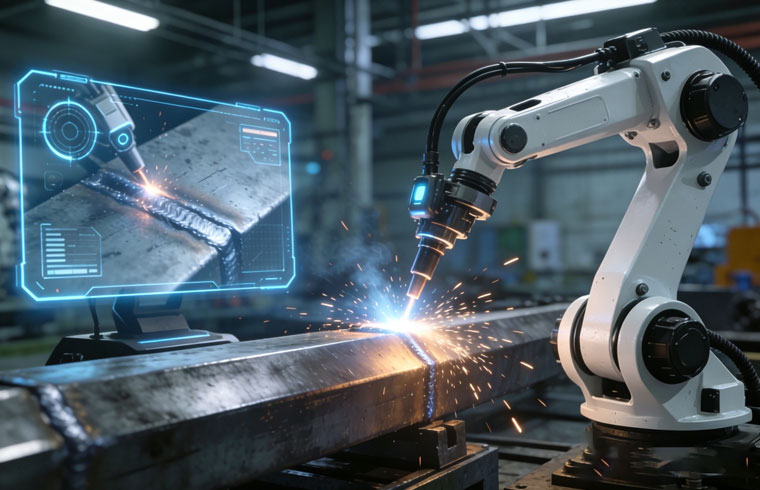
Robot welding, by contrast, uses an industrial robot or collaborative robot to control torch movement according to programmed paths and welding parameters. Modern systems may also incorporate sensors, seam tracking, machine vision, workpiece positioners, and adaptive controls.
This difference has an important consequence. Manual welding places much of the process intelligence in the operator. Robotic welding moves more of that intelligence into the production system.
That means robotic welding performance depends on much more than purchasing a robot. Part consistency, fixture design, weld accessibility, joint preparation, programming strategy, sensing technology, and production flow all influence the final result.
Robotic Welding vs Manual Welding: Key Differences
The following comparison provides a practical overview of where each method tends to perform best.
| Factor | Robotic Welding | Manual Welding |
|---|---|---|
| Weld consistency | Highly repeatable when parts and parameters are controlled | Depends heavily on welder skill and working conditions |
| Production stability | Strong for repetitive operations and defined cycles | Can vary between operators and shifts |
| Flexibility | Increasing with vision, sensing and teach-free technology | Very high for unpredictable or frequently changing work |
| Complex part variation | Requires sensing, programming or adaptive technology | Skilled welders can respond immediately |
| Process repeatability | Excellent | Moderate to high depending on operator |
| Worker exposure | Reduces direct exposure to arc, heat and repetitive tasks | Requires the welder to remain close to the process |
| Scaling production | Easier once the process has been standardized | Usually requires additional skilled labor |
| Setup requirements | Requires fixtures, programming and process planning | Usually requires less automation infrastructure |
| Best use case | Repeatable industrial production | Highly variable, repair or specialized welding |
The table also highlights why robotic welding vs manual welding should not be treated as an absolute winner-versus-loser comparison. Each approach is strongest under different production conditions.
Weld Quality and Consistency
One of the most significant advantages of robotic welding is process repeatability.
Once a welding path and process parameters have been validated, the robot can repeat the same movement with controlled speed, torch angle, position, and sequence. This can reduce variation caused by fatigue, inconsistent travel speed, or differences between operators.
However, repeatability should not be confused with automatic quality.
A robot will repeat both a good process and a bad process very consistently. If a fixture positions a component incorrectly, if the joint gap changes beyond the system’s tolerance, or if the weld parameters are poorly selected, automation alone will not solve the problem.
This is why successful robotic welding begins upstream of the weld itself.
Part manufacturing accuracy, joint preparation, fixture repeatability, clamping strategy and accessibility all influence whether the robot can reproduce a stable weld.
Manual welding has a different advantage. A skilled welder can recognize a changing joint gap, compensate for imperfect fit-up, modify travel speed and change technique without stopping production to reprogram a system.
For highly inconsistent workpieces, this human adaptability can still be extremely valuable.
Productivity Is More Than Welding Speed
When comparing robotic welding vs manual welding, many manufacturers focus immediately on travel speed. That is only one part of productivity.
The real production cycle includes loading, positioning, clamping, welding, repositioning, inspection, unloading and preparation for the next part.
A robot that welds quickly but waits for parts most of the time may deliver less improvement than expected. By contrast, a properly designed robotic cell can coordinate welding with positioners, fixtures and material handling so that non-welding time is reduced as well.
This is where well-integrated robotic welding systems can create value beyond the welding arc itself. The objective is not simply to move the torch faster. It is to make the entire production process more predictable.
Manual welding may remain highly efficient for one-off parts, repair jobs and workpieces that require extensive repositioning or judgment. Robotic welding becomes particularly valuable when the same production sequence needs to be repeated reliably over many cycles.
Flexibility in High-Mix and Low-Volume Production
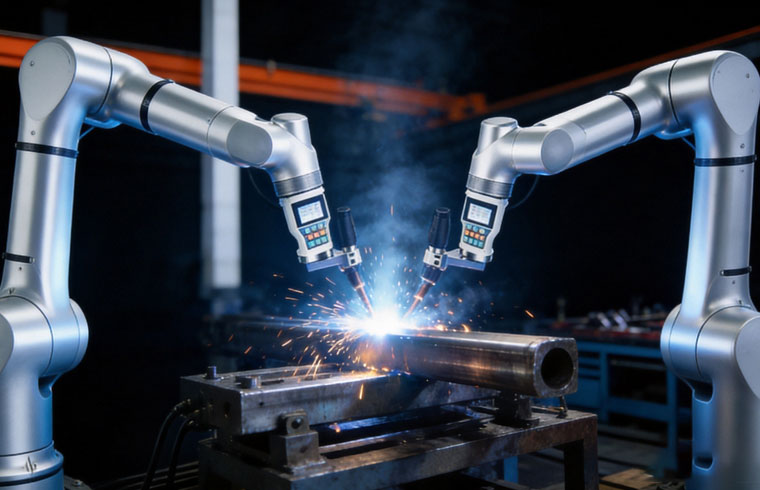
Traditional robotic welding systems were often associated with highly repetitive, high-volume production. That perception is changing.
Manufacturers increasingly need to produce more product variants without losing efficiency. This creates a difficult challenge: automation must become more flexible without sacrificing repeatability.
Technologies such as 3D vision, seam recognition, automatic path generation, adaptive welding and teach-free programming are expanding the range of workpieces that robots can handle.
Instead of manually teaching every weld point for every variation, newer systems can use workpiece data and sensing technologies to identify weld locations and adjust paths.
This is especially important when evaluating robotic welding vs manual welding for high-mix production. Manual welding still provides excellent immediate adaptability, but intelligent robotic systems are steadily reducing the programming burden associated with product variation.
For manufacturers, this changes the automation decision. The relevant question is no longer simply whether every workpiece is identical. It is whether the differences between workpieces can be identified and controlled reliably.
Labor, Skills, and Workplace Safety
Robotic welding does not eliminate the need for welding expertise. It changes where that expertise is applied.
In a manual process, much of the welder’s skill is used directly at the arc. In an automated environment, experienced personnel may spend more time defining welding procedures, validating parameters, optimizing fixtures, solving quality problems and improving production processes.
This distinction matters because manufacturers should not view automation as replacing welding knowledge with machinery.
A robot still needs a sound welding process.
The difference is that once the process has been developed correctly, automation can reproduce it consistently.
There is also an important workplace consideration. Welding can expose operators to heat, arc radiation, fumes, spatter, repetitive movements and difficult working positions. Automation can move workers away from continuous direct exposure during repetitive production.
The result can be a production environment in which skilled personnel spend more time controlling and improving the process rather than repeatedly performing the same physical motion.
When Manual Welding Is Still the Better Choice
Manual welding remains an important manufacturing process and will continue to be useful even as automation develops.
It is particularly effective when every workpiece is significantly different, when joint locations are unpredictable, or when a skilled welder needs to make frequent judgments during the weld.
Repair work is a good example. The condition of a damaged component may not be known until the welder begins the job. Surface condition, distortion, access and joint geometry can vary substantially. Human observation and immediate adjustment can be more practical than developing an automated routine.
Very low-repeatability production may also favor manual welding. If a component is manufactured only occasionally and requires extensive system preparation, automation may not provide enough process benefit.
The key point is that manual welding should not be viewed as outdated. It remains the more suitable technology whenever human adaptability provides greater value than process repetition.
When Robotic Welding Creates More Value
Robotic welding becomes increasingly attractive as repeatability increases.
If a manufacturer produces similar components every day, uses defined weld sequences and needs consistent quality between shifts, automation can remove many sources of process variation.
Typical applications include repetitive structural components, fabricated machinery parts, vehicle structures, tanks, frames and production-line assemblies.
Robotic welding can be particularly valuable when several of the following conditions occur together:
- The same or similar welds are repeated frequently.
- Weld quality needs to remain stable across long production periods.
- Production capacity must increase without relying entirely on additional manual welding stations.
- Parts can be located consistently in fixtures.
- Welding conditions are suitable for standardized procedures.
- Operators perform repetitive or ergonomically difficult welding tasks.
- Future production expansion is expected.
The more of these conditions that apply, the stronger the case for automation becomes.
How to Decide Between Robotic Welding and Manual Welding
A useful robotic welding vs manual welding evaluation should begin with the workpiece rather than the robot.
Start by examining part repeatability. If component geometry, joint position and fit-up vary considerably, determine whether those variations can be controlled through better manufacturing, fixture design or sensing technology.
Next, examine the welding sequence. Parts with many repeated seams often provide stronger opportunities for automation than components containing only a small number of irregular welds.
Accessibility is another critical factor. A robot needs sufficient working space, appropriate torch orientation and a clear collision-free path. Positioners may be required to place the joint in a suitable welding position.
Production planning should also consider what happens outside the robotic cell. If loading and unloading become bottlenecks, optimizing only the welding operation will not produce the expected overall improvement.
Finally, think beyond today’s production requirement. A welding system designed only for one current product may become restrictive when new products are introduced. Flexible fixtures, adaptable programming and sensing technologies can improve the long-term usefulness of automation.
Why Hybrid Welding Is Often the Better Strategy
One of the biggest mistakes in the robotic welding vs manual welding discussion is assuming that a manufacturer must choose only one.
In many factories, the most effective strategy is hybrid production.
Robots can handle highly repetitive welds where consistency, cycle stability and worker exposure matter most. Skilled welders can then concentrate on prototypes, repairs, complex joints, difficult access areas and components with significant variation.
This approach uses the strengths of both processes.
The robot provides repeatability.
The welder provides adaptability.
From a production-management perspective, this can also make automation easier to introduce. Instead of attempting to automate every weld immediately, manufacturers can identify the most stable and repetitive operations first.
Successful welding automation is therefore often a process of selective automation rather than complete automation.
The Role of 3D Vision and Teach-Free Welding
Programming has historically been one of the major challenges associated with robotic welding, especially when production involves multiple product types.
Modern vision-guided and teach-free systems are designed to reduce this barrier.
A 3D vision system can identify features on a workpiece and provide information about joint position or geometry. Combined with seam recognition and path-planning software, this allows the robotic system to respond more intelligently to variations.
Teach-free welding takes the concept further by reducing dependence on conventional point-by-point robot teaching.
For manufacturers working with larger components or frequently changing products, this can significantly change the robotic welding vs manual welding calculation. Tasks that previously appeared too variable for automation may become practical when the system can identify and adapt to workpiece differences.
The important distinction is that intelligent sensing does not remove the need for process engineering. Instead, it gives the automation system more information with which to execute the welding process correctly.
Common Mistakes When Moving From Manual to Robotic Welding
Automation projects often underperform when companies focus on the robot but overlook the surrounding process.
One common mistake is assuming that a robot will automatically correct inconsistent parts. If the joint location changes unpredictably and no sensing system is available, the robot may simply follow the programmed path even when the actual seam has moved.
Another mistake is underestimating fixture design. A fixture is not merely a device that holds the workpiece. It establishes the repeatable relationship between the component and the programmed welding path.
Manufacturers should also avoid automating an unstable manual process. If welding procedures, part tolerances and preparation standards are inconsistent before automation, those problems should be understood before they are transferred into a robotic system.
The strongest automation projects usually begin with process analysis, not equipment selection.
Robotic Welding vs Manual Welding for Long-Term Manufacturing
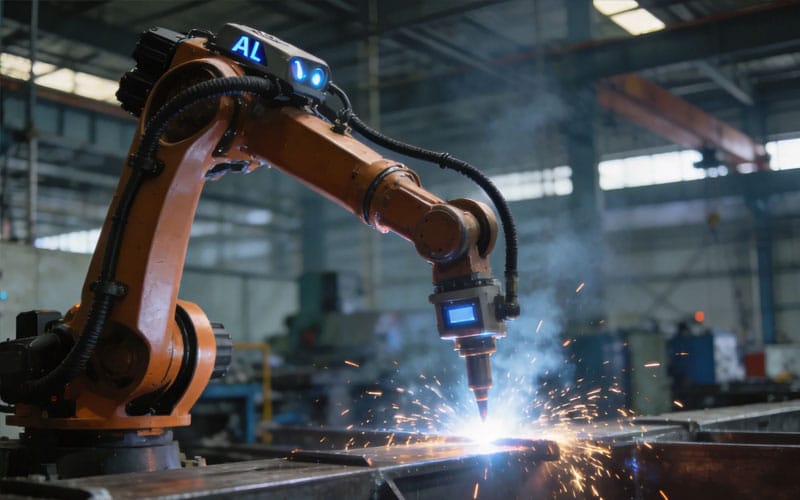
For long-term manufacturing, the decision becomes increasingly strategic.
Manual welding provides immediate flexibility and remains essential for specialized work. Robotic welding provides a platform for repeatable production and can integrate with other manufacturing processes such as material handling, positioning, inspection and production-line control.
The value of automation therefore becomes greater when welding is considered as part of the entire manufacturing system.
A robotic cell can eventually become one component of a larger automated production line in which workpieces are transported, positioned, welded and moved to the next process with less manual intervention.
This systems-level view is particularly important for manufacturers planning future capacity expansion.
Instead of asking only, “Can this weld be automated?”, a better question is:
“How can this welding process fit into a more stable and scalable production system?”
Conclusion
There is no universal winner in robotic welding vs manual welding.
Manual welding remains highly effective when production requires human judgment, frequent adjustment and immediate adaptability. Robotic welding becomes more valuable when operations are repetitive, process consistency matters, production needs to scale and the surrounding manufacturing conditions can be controlled.
The strongest decision therefore starts with the workpiece, the welding process and the production objective.
For some manufacturers, manual welding will remain the right solution. For others, automation can provide a more predictable manufacturing process. And in many cases, combining skilled welders with robotic systems delivers a better balance than choosing either approach alone.
As technologies such as 3D vision, adaptive control and teach-free programming continue to develop, the range of applications suitable for robotic welding is expanding. The question is increasingly becoming not whether welding can be automated, but where automation creates meaningful manufacturing value.
FAQ
Is robotic welding better than manual welding?
Neither method is universally better. Robotic welding offers strong repeatability, process stability and productivity for standardized work, while manual welding provides greater adaptability for irregular parts, repairs and changing welding conditions.
Is robotic welding faster than manual welding?
Robotic welding can deliver more consistent cycle times in repetitive production, but overall productivity also depends on loading, fixtures, positioning and material flow. A well-designed production system matters more than welding speed alone.
Can robotic welding handle low-volume production?
Yes. Modern 3D vision, seam recognition and teach-free technologies are making robotic welding more practical for high-mix and lower-volume production, especially when workpiece variations can be identified and controlled.
Can robotic welding completely replace skilled welders?
In most manufacturing environments, that is not the objective. Skilled welding knowledge is still required for process development, parameter validation, quality control, complex work and troubleshooting. Automation changes how that expertise is used.
How do I choose between robotic welding and manual welding?
Evaluate workpiece repeatability, weld complexity, fit-up consistency, production volume, cycle requirements, fixture capability and future expansion. Repetitive controlled processes generally provide stronger opportunities for robotic welding.
Need Help Choosing the Right Robotic Welding Solution?
If you’re unsure whether robotic welding or manual welding is the better fit for your production process, SHUIPO can help evaluate your workpieces, welding requirements, production flow and automation goals. Our team develops robotic welding, teach-free welding and intelligent automation solutions for different manufacturing applications. Contact SHUIPO for a project consultation and identify the right level of automation for your production needs.