
Mục lục
Giới thiệu
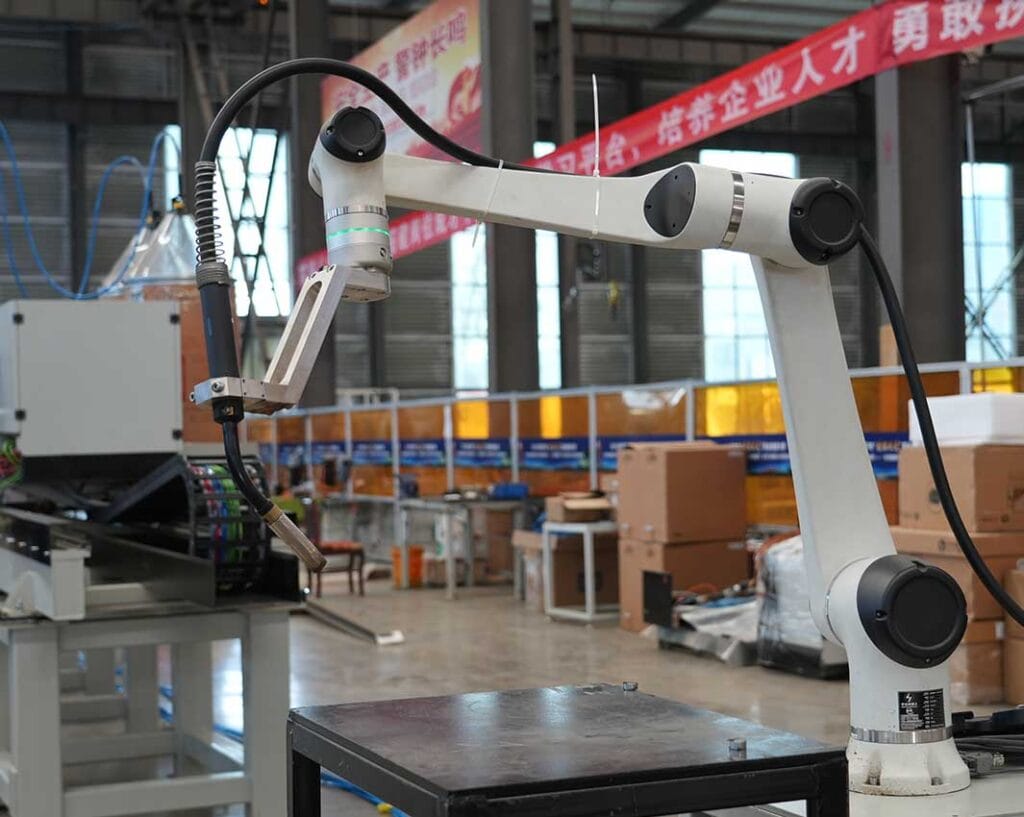
Một cánh tay hàn robot là một trong những bộ phận dễ thấy nhất của hệ thống tự động hóa hàn, nhưng hiệu suất của nó không thể được đánh giá bằng tầm với, tải trọng hoặc tốc độ di chuyển một mình. cánh tay phải đặt mỏ hàn ở đúng vị trí, duy trì một góc phù hợp với khớp, di chuyển trơn tru qua đường được lập trình, tránh va chạm và làm việc với các thiết bị cố định, bộ định vị, cảm biến, thiết bị hàn và thiết bị an toàn.
Đây là lý do tại sao việc lựa chọn cánh tay hàn robot nên bắt đầu với phôi thay vì với bảng thông số kỹ thuật của robot.
Một thành phần nhỏ gọn với các mối hàn trên một số mặt có thể yêu cầu tính linh hoạt mạnh mẽ của cổ tay nhưng chỉ đạt được vừa phải. một cấu trúc chế tạo dài có thể cần một robot gắn trên trục tuyến tính. một gói đèn pin nặng có thể tăng tải trọng và yêu cầu thời điểm cổ tay, trong khi sản xuất hỗn hợp cao có thể làm cho tính linh hoạt lập trình và cảm biến quan trọng hơn tốc độ tối đa.
Cánh tay hàn robot phù hợp do đó là một trong những phù hợp với quá trình hàn hoàn chỉnh. hướng dẫn này giải thích các yếu tố kỹ thuật chính ảnh hưởng đến việc lựa chọn robot, cách cấu hình cánh tay ảnh hưởng đến hiệu suất hàn và những gì các nhà sản xuất nên đánh giá trước khi tích hợp robot vào hệ thống hàn tự động.
Cánh tay hàn robot là gì?
Cánh tay hàn robot là một bộ điều khiển đa trục có thể lập trình được sử dụng để định vị và di chuyển mỏ hàn dọc theo đường hàn xác định.
Hầu hết các ứng dụng hàn công nghiệp đều sử dụng robot có khớp nối có nguồn gốc từ danh mục rộng hơn của robot công nghiệp. Nhiều khớp quay của chúng cho phép robot thay đổi cả vị trí và hướng của dụng cụ trong khi di chuyển xung quanh các phôi phức tạp.
Một cánh tay hàn robot điển hình hoạt động cùng với một số thành phần khác:
- hàn ngọn đuốc
- nguồn điện hàn
- feeder dây
- bộ điều khiển robot
- lịch thi đấu
- định vị phôi
- hệ thống cảm biến đường may
- thiết bị an toàn
- hệ thống quản lý cáp
Cánh tay cung cấp chuyển động có kiểm soát, nhưng nó không tự tạo ra một quá trình hàn thành công.
Một robot có thể đi theo một đường dẫn được lập trình một cách chính xác trong khi vẫn tạo ra kết quả kém nếu phôi được định vị không chính xác, đường may di chuyển ra ngoài vị trí dự kiến, ngọn đuốc không thể duy trì góc yêu cầu hoặc các thông số hàn không phù hợp.
Sự khác biệt này là cơ bản khi lập kế hoạch tự động hóa hàn công nghiệp.
Tại sao cánh tay sáu trục lại phổ biến trong hàn robot
Robot khớp nối sáu trục được sử dụng rộng rãi để hàn vì hàn hiếm khi chỉ liên quan đến vị trí.
Ngọn đuốc cũng cần định hướng chính xác.
Các trục robot đầu tiên thường tạo ra chuyển động lớn hơn cần thiết để tiếp cận các khu vực khác nhau của phôi, trong khi trục cổ tay cung cấp khả năng kiểm soát hướng tốt hơn xung quanh mối hàn.
Sự kết hợp đó cho phép một cánh tay hàn robot tiếp cận các khớp nối từ các hướng khác nhau và theo hình học ba chiều.
Chuyển động sáu trục đặc biệt hữu ích cho:
- khung
- dấu ngoặc
- cấu trúc máy móc
- xe tăng
- thành phần cong
- cụm ống
- chế tạo nhiều mặt
- các thành phần chứa các khớp ở một số hướng
Tính linh hoạt rất có giá trị nhưng nó tạo ra một thách thức kỹ thuật khác.
Robot có thể có khả năng vật lý để tiếp cận khớp trong khi đi vào cấu hình cổ tay khó xử khiến đường hàn không ổn định hoặc tăng nguy cơ va chạm.
Do đó, tầm với của robot cần được đánh giá cùng với định hướng.
Các yếu tố chính khi lựa chọn cánh tay hàn robot
Lựa chọn robot nên kết nối trực tiếp với quá trình hàn.
| Hệ số lựa chọn | Tại sao nó quan trọng | Rủi ro thường gặp nếu bị bỏ qua |
|---|---|---|
| Tiếp cận | Xác định không gian làm việc có thể truy cập | Robot đạt đến khu vực nhưng không phải là hướng ngọn đuốc cần thiết |
| Tải trọng | Hỗ trợ ngọn đuốc và thiết bị gắn kết | Gói công cụ vượt quá khả năng thực tế của robot |
| Khoảnh khắc cổ tay | Tài khoản cho chiều dài công cụ và trọng tâm | Tải trọng cơ học quá mức trên trục cổ tay |
| Cấu hình trục | Xác định tính linh hoạt định hướng | Di chuyển khó khăn xung quanh các khớp phức tạp |
| Độ lặp lại | Hỗ trợ thực thi đường dẫn nhất quán | Giảm tính nhất quán về vị trí |
| Phong bì làm việc | Xác định diện tích hàn có thể sử dụng | Đồ đạc hoặc bộ phận chặn chuyển động của robot |
| Vị trí lắp | Thay đổi không gian làm việc có sẵn | Khả năng tiếp cận kém với các vùng hàn cụ thể |
| Trục ngoài | Mở rộng khả năng chuyển động | Các bộ phận lớn vượt quá phạm vi robot cố định |
| Phương pháp lập trình | Nh hưởng đến việc thiết lập và chuyển đổi | Sản xuất hỗn hợp cao trở nên kém hiệu quả |
| Khả năng tương thích cảm biến | Hỗ trợ sửa đường dẫn | Robot không thể quản lý biến thể khớp bình thường |
Những yếu tố này không nên được đánh giá độc lập.
Ví dụ, một robot có tầm với xa hơn có thể có các đặc tính tải trọng khác nhau hoặc có thể trở nên kém hiệu quả hơn ở gần mép đường bao làm việc của nó.
Ứng dụng hoàn chỉnh xác định sự cân bằng tốt nhất.
Robot đạt được nhiều hơn khoảng cách tối đa
Tầm với của robot là một trong những thông số kỹ thuật đầu tiên mà các nhà sản xuất so sánh, nhưng tầm với tối đa có thể gây hiểu nhầm.
Một nhà sản xuất có thể thấy rằng khớp nối xa nhất là 1,8 mét từ cơ sở robot và chọn một cánh tay với hơn 1,8 mét tầm với được công bố một chút.
Về mặt hình học, điều đó có vẻ đủ.
Trong thực tế, robot có thể cần thêm không gian để duy trì góc mỏ hàn chính xác. vật cố định có thể chặn một hướng tiếp cận. cổ tay robot có thể xoay về phía giới hạn khớp của nó, hoặc cáp có thể can thiệp vào phôi.
Do đó, lớp vỏ hàn có thể sử dụng được nhỏ hơn và phức tạp hơn một vòng tròn đơn giản xung quanh đế robot.
Một đánh giá mạnh mẽ hơn xem xét:
- chiều dài ngọn đuốc thực
- định hướng ngọn đuốc
- hình học vật cố định
- các cấu trúc xung quanh
- chuyển động cổ tay
- giới hạn khớp robot
- giải phóng mặt bằng cáp
- vị trí phôi
Mục tiêu là giữ các đường hàn quan trọng bên trong một phần thoải mái của phạm vi hoạt động của robot thay vì liên tục buộc cánh tay đến giới hạn vật lý của nó.
Trọng tải và mô men cổ tay quan trọng trong hàn
Tải trọng là một đặc tả khác có thể bị hiểu nhầm.
Ngọn đuốc hàn có thể không xuất hiện đặc biệt nặng, nhưng gói hoàn chỉnh gắn trên robot có thể bao gồm:
- ngọn đuốc
- cảm biến va chạm
- cảm biến đường may
- máy ảnh hoặc cảm biến laser
- khung gắn
- kết nối cáp
- các thành phần liên quan đến dây
Robot cần hỗ trợ toàn bộ gói công c.
Quan trọng hơn, vấn đề phân phối trọng lượng.
Một cụm đèn pin dài tạo ra tải trọng cơ học khác với một dụng cụ nhỏ gọn có cùng khối lượng vì trọng tâm nằm xa cổ tay robot hơn.
Điều này tạo ra một khoảnh khắc lớn hơn.
Vì lý do đó, việc lựa chọn cánh tay hàn robot nên xem xét cả tải trọng và trọng tâm của thiết bị cuối cánh tay thực tế.
Bỏ qua điều này có thể tạo ra một hệ thống có vẻ chấp nhận được theo tổng trọng lượng nhưng hoạt động gần các giới hạn cơ học không mong muốn trong quá trình hàn thực.
Định hướng ngọn đuốc có thể quan trọng hơn tầm với
Trong tự động hóa hàn, đạt được mối nối chỉ là một nửa yêu cầu.
Ngọn đuốc phải chạm tới nó một cách chính xác.
Hình học khớp xác định hướng ngọn đuốc thích hợp, hướng đi du lịch, và góc làm việc.Những điều kiện này có thể thay đổi liên tục thông qua đường nối cong hoặc ba chiều.
Điều này trở nên đặc biệt quan trọng khi phôi có chứa các khớp nối:
- góc trong
- behind structural members
- near fixture clamps
- around curved surfaces
- on opposite faces
- inside partially enclosed structures
A robotic welding arm must maintain enough wrist freedom to follow these joints without creating abrupt movement.
This is why simulation is valuable before equipment is finalized.
A digital model can show whether a proposed robot can reach all seams while maintaining appropriate tool orientation and avoiding collisions.
Cách gắn Robot thay đổi phong bì làm việc
A robotic welding arm does not always need to stand on the floor beside the workpiece.
Mounting position can significantly change access.
Common configurations include:
- floor-mounted
- elevated pedestal-mounted
- wall-mounted
- inverted or overhead-mounted
- rail-mounted
Each arrangement creates a different working envelope.
A floor-mounted robot may provide simple integration for compact workpieces. An elevated pedestal can improve access to taller structures. Overhead mounting can free floor space and provide better access to some large assemblies.
Rail mounting adds another dimension.
Instead of relying only on arm reach, the entire robot can travel along a linear axis.
This can be particularly useful when welding long structures because the robot can remain within a favorable working range while moving between welding zones.
The best mounting configuration should therefore follow workpiece geometry rather than workshop habit.
Khi một trục tuyến tính trở nên cần thiết
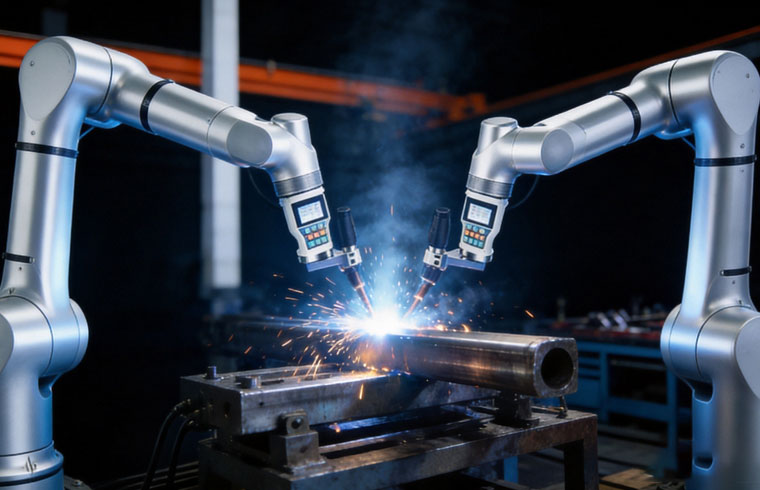
A fixed robotic welding arm works well when all required joints fall inside its usable workspace.
Long workpieces create a different situation.
If seams are distributed across several meters, simply selecting a very long robot arm may not produce the best welding geometry.
A linear track can move the robot along the length of the workpiece.
This creates several advantages:
- larger effective working range
- reduced extreme arm extension
- better torch orientation
- easier access to multiple welding zones
- more consistent robot posture
The linear axis effectively becomes another controlled robot axis.
However, additional motion also increases programming complexity.
Engineers need to determine when the track should reposition between welds and when coordinated motion between the robot and track is beneficial.
For long fabricated structures, this system-level planning is often more important than selecting the arm with the greatest standalone reach.
Tại sao bộ định vị phôi làm giảm độ phức tạp của cánh tay
Another way to expand robot capability is to move the workpiece instead of the robot.
A positioner can rotate or tilt the component so that the weld is presented to the robotic welding arm from a more favorable direction.
This is especially valuable for:
- cylindrical parts
- khung
- multi-sided assemblies
- long curved joints
- đường nối chu vi
- heavy fabricated components
Without a positioner, the robot may need to reach underneath the component or rotate its wrist into an extreme configuration.
With a positioner, the same joint can sometimes be moved into a more accessible orientation.
This often produces smoother robot motion.
In more advanced cells, the robot and positioner move in coordination. A circumferential seam, for example, may be completed through controlled workpiece rotation while the robot maintains a stable torch relationship.
Moving the part can therefore be as important as moving the arm.
Thiết kế đồ đạc ảnh hưởng trực tiếp đến độ chính xác của cánh tay robot
Robotic welding arms are valued for repeatable motion, but that repeatability only creates value when the workpiece repeats as well.
If a fixture locates one component differently from the next, the robot can follow exactly the same path while the real weld seam has moved.
This is especially important for fixed-path welding.
Một vật cố định tốt nên:
- establish reliable locating references
- hold the component consistently
- maintain torch access
- avoid unnecessary robot interference
- allow practical loading
- consider welding distortion
Fixture design and robot path design should therefore happen together.
A clamp placed in the wrong location can block an otherwise ideal welding approach.
Similarly, a fixture that requires the robot to reach deep around structural members may reduce effective workspace even when the workpiece itself appears compact.
The robot, fixture, and component should be treated as one geometric system.
Làm thế nào Seam Sensing mở rộng khả năng cánh tay
A robotic welding arm repeats its programmed motion extremely well, but real fabricated components can contain variation.
Cutting, forming, assembly, tack welding, and fixture loading can shift the actual seam away from its nominal position.
Sensing gives the robot additional information about the real workpiece.
A system may use:
- touch sensing
- laser seam tracking
- vision
- 3D sensing
- other joint-detection methods
The objective is not to change the fundamental capabilities of the arm.
The objective is to determine where the arm should move.
This distinction matters.
Sensing does not give a short-reach robot more physical reach. It does not make an inaccessible joint accessible. It does not fix a welding torch that cannot fit between two components.
What it can do is help the existing robotic welding arm align its repeatable motion more accurately with the real weld location.
For applications with meaningful but controlled part variation, hệ thống hàn robot can combine arm movement, workpiece positioning, and sensing within the same automated process.
Cánh tay hàn robot để sản xuất hỗn hợp cao
A robot arm designed for one repeated component can rely heavily on fixed programming.
High-mix manufacturing demands more flexibility.
When workpieces change regularly, programming time can become a significant part of the automation process.
Several factors become more important:
- simplified teaching
- offline programming
- reusable welding programs
- geometry-based programming
- sensing
- flexible fixtures
- teach-free methods
The robotic welding arm itself may be mechanically capable of handling many components, but the system is not truly flexible if every product change requires extensive manual reprogramming.
This is why high-mix robot selection should consider software and programming workflow alongside hardware specifications.
A technically capable arm with an inefficient programming process may create unnecessary production delays.
Cánh tay hàn robot vs Cánh tay hàn hợp tác
Collaborative robots are increasingly used in welding applications, but they should not automatically replace conventional industrial welding robots.
Both have strengths.
| Yếu tố | Industrial Robotic Welding Arm | Collaborative Welding Arm |
|---|---|---|
| Motion speed | Often designed for faster industrial operation | Often emphasizes controlled collaborative operation |
| Programming | Can require more specialist knowledge | Frequently designed for simplified teaching |
| Payload range | Broad range available | Often more limited |
| Workcell design | Common in dedicated cells | Often supports more flexible layouts |
| Sản xuất hỗn hợp cao | Strong with suitable programming and sensing | Often attractive for frequent changeover |
| Large structures | Can integrate effectively with rails and external axes | Depends heavily on reach and system layout |
| Safety | Complete cell requires safety engineering | Welding process still requires application-level protection |
The right choice depends on production requirements.
For highly repetitive production with demanding cycle requirements, a conventional industrial robot may be the stronger option.
For changing workpieces where programming and redeployment are important, a collaborative configuration may offer practical advantages.
Độ lặp lại không giống như độ chính xác hàn
This distinction is essential.
Robot repeatability refers to how consistently the arm can return to a programmed position.
Welding accuracy depends on whether that programmed position matches the real joint.
A robot may have excellent repeatability while the workpiece shifts several millimeters between cycles.
In that case, the robot is repeating accurately but welding inaccurately relative to the seam.
This is why the complete accuracy chain should be considered:
workpiece manufacturing → fixture location → sensor measurement → robot path → torch position.
Weakness anywhere in this chain can influence the final weld.
Robotic welding arm specifications should therefore never be evaluated separately from production tolerances.
Tốc độ Robot Không Nên Là Tiêu Chí Lựa Chọn Chính
A faster arm does not automatically create a faster welding process.
Welding travel speed is determined primarily by the welding procedure, material, joint design, and required weld characteristics.
The robot often spends only part of the total production cycle performing rapid movement between joints.
Other time is used for:
- hàn hàn
- loading
- clamping
- sensing
- workpiece positioning
- cleaning
- unloading
Increasing robot movement speed has limited value if welding or handling remains the dominant cycle component.
Instead of asking which robot is fastest, manufacturers should ask where time is actually being consumed across the complete workcell.
That produces a more useful automation decision.
Quản lý cáp là một phần của thiết kế cánh tay
Cables and hoses are easy to overlook during early robot selection.
During real operation, however, the robotic welding arm may rotate through complex paths while carrying:
- welding cables
- wire feed connections
- sensor cables
- gas lines
- utility connections
Poor routing can restrict movement, increase wear, or create interference with the workpiece.
Complex wrist rotation is particularly important.
A robot path that looks acceptable in a simplified simulation may create cable twisting when the actual torch package is installed.
Cable routing should therefore be evaluated during path design.
The most elegant geometric robot movement is not useful if the welding package cannot follow it reliably over repeated cycles.
Cấu hình Robot ảnh hưởng đến rủi ro va chạm như thế nào
Robotic welding cells contain many potential collision objects:
- workpiece
- lịch thi đấu
- positioner
- clamps
- table
- hàn ngọn đuốc
- sensors
- nearby robots
- safety structures
Complex components can create narrow access areas where the robot wrist passes close to surrounding geometry.
Collision analysis is therefore necessary during cell development.
Importantly, engineers should analyze not only welding paths but also approach and exit movements.
The robot may complete the weld successfully but collide while repositioning to the next seam.
Stored safe positions and structured transitions between welding zones can reduce this risk.
Simulation provides a useful first check, while physical validation remains necessary during commissioning.
Hàn hai cánh tay và nhiều robot
Some large components contain enough welding work to justify more than one robotic arm.
Two robots may work on different sides of a structure or divide a large number of seams between separate zones.
This can reduce excessive robot travel.
However, adding additional arms introduces new considerations:
- overlapping workspaces
- collision avoidance
- shared positioners
- trình tự hàn
- phân phối nhiệt
- truy cập vật cố định
- cycle balance
Two robotic welding arms only improve productivity when the work can be divided logically.
If both robots constantly wait for the same positioning movement, the system may gain less than expected.
Multi-robot design should therefore begin with task allocation rather than robot quantity.
Các lỗi lựa chọn cánh tay hàn robot phổ biến
One of the most common mistakes is choosing the arm based only on maximum reach.
Another is considering payload without calculating the tool center of gravity.
Manufacturers may also overlook real torch geometry and test robot access using only a simplified robot flange.
Another frequent problem is designing around one ideal component.
Normal production parts should be measured because real dimensional variation may change sensing or fixture requirements.
Selecting a robot before designing the workpiece position can also create unnecessary complexity.
Sometimes a smaller arm combined with a suitable positioner performs better than a larger robot attempting to reach every joint around a fixed component.
Finally, choosing the robot without considering future product families can limit the flexibility of the cell.
The best selection balances present requirements with realistic future production needs.
Một quá trình lựa chọn cánh tay hàn robot thực tế
A structured evaluation can reduce many of these mistakes.
Bước 1: Phân tích phôi
Document:
- overall dimensions
- weight
- weld locations
- joint geometry
- định hướng bắt buộc
- access restrictions
- expected variation
Bước 2: Xác định Công cụ hàn
Include the actual:
- ngọn đuốc
- bracket
- sensor
- collision device
- cable package
This establishes realistic payload and geometry.
Bước 3: Xác định chuyển động phôi
Decide whether the component should remain fixed or use:
- rotary positioner
- tilting positioner
- multi-axis positioner
- indexing table
Bước 4: Đánh giá Robot Reach và Orientation
Check the complete welding path, not individual points.
The robot should maintain suitable orientation without repeatedly approaching joint limits.
Bước 5: Xem xét chuyển động bên ngoài
Large workpieces may require a rail or other external axis.
Bước 6: Phân tích Variation
Determine whether fixture control is enough or whether seam sensing is required.
Bước 7: Đánh giá các yêu cầu lập trình
High-mix manufacturing may require more flexible programming than highly repetitive production.
Bước 8: Xác thực ô hoàn chỉnh
Review loading, welding, positioning, unloading, safety, and maintenance access before finalizing the layout.
This sequence keeps equipment selection tied to the manufacturing problem.
Vai trò của cánh tay hàn robot trong hàn thông minh
The next stage of robotic welding development is increasingly focused on giving the arm better information about the real workpiece.
Traditional robotic welding is based primarily on predefined trajectories.
More advanced systems combine robot motion with:
- Tầm nhìn 3D
- seam recognition
- path generation
- digital models
- adaptive correction
- workpiece identification
This changes the role of the arm.
The robot remains the motion platform, but the welding path can increasingly be generated or adjusted using information gathered from the component.
For high-mix manufacturing, this is especially significant.
The mechanical arm may already have enough reach and flexibility to weld several product families. The limitation has often been programming and the ability to handle joint variation.
Better sensing and programming methods help remove some of that limitation.
Tại sao lớn hơn không phải lúc nào cũng tốt hơn
Choosing a larger robotic welding arm can appear to provide more flexibility because it offers greater reach and payload.
But oversizing can introduce disadvantages.
A larger robot may:
- require more installation space
- create a larger safety area
- have different dynamic behavior
- reduce access around compact fixtures
- complicate cell layout
The objective should be appropriate capability, not maximum capability.
If a smaller arm covers the required workspace comfortably and a positioner presents joints effectively, that configuration may produce a simpler welding cell.
Likewise, a larger robot becomes useful when workpiece geometry genuinely requires the additional working range or payload.
Good engineering avoids selecting capacity that does not solve a real production requirement.
Xu hướng tương lai của cánh tay hàn robot
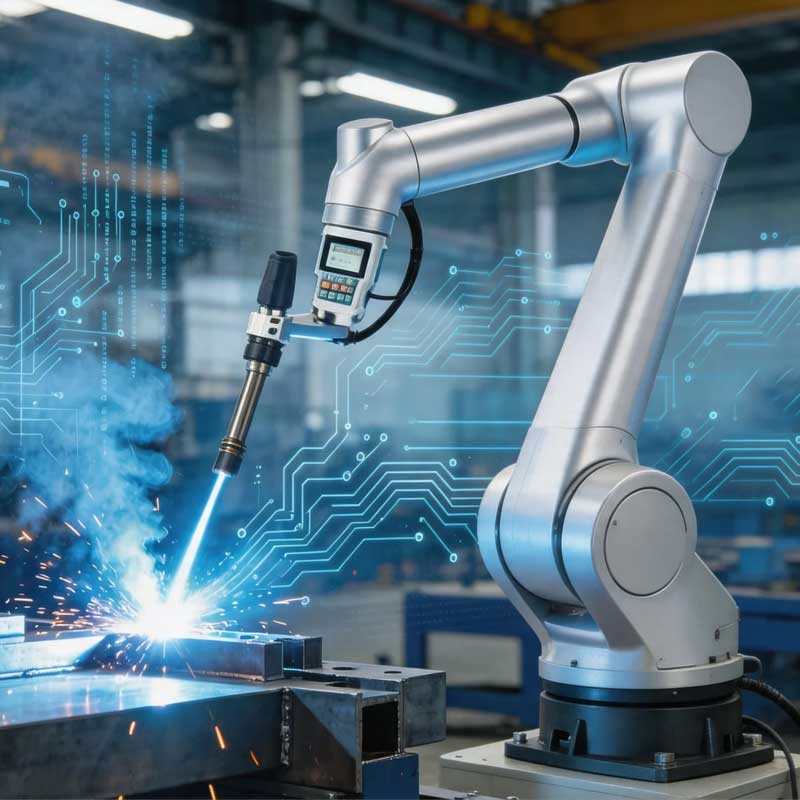
Robotic welding arms are becoming part of increasingly connected and adaptive production systems.
Mechanical improvements continue, but much of the important progress is happening in how robots are programmed and how they receive information.
Several developments are particularly relevant:
- simplified programming
- automated path generation
- 3D workpiece recognition
- intelligent seam detection
- adaptive welding
- offline simulation
- virtual commissioning
- multi-axis coordination
These developments reduce dependence on fixed point-by-point programming.
Future robotic welding arms will still need appropriate reach, payload, and motion capability, but their effectiveness will increasingly depend on how well they integrate with sensing and digital production information.
The best automation systems will combine mechanical capability with better understanding of the actual workpiece.
Kết luận
A robotic welding arm should be selected as part of a complete welding process, not as an isolated piece of equipment.
Reach determines where the robot can work, but torch orientation determines whether it can weld correctly. Payload matters, but tool center of gravity and wrist moment also need to be considered. Fixtures establish workpiece position, while positioners and external axes can simplify difficult robot movement.
For high-mix production, programming flexibility and sensing may become as important as mechanical specifications.
The strongest robotic welding arm configuration is therefore not necessarily the largest, fastest, or most complex.
It is the one that can reach the real joints, maintain suitable torch orientation, operate within a stable mechanical range, and integrate effectively with the workpiece, fixture, sensing, and production flow.
Câu hỏi thường gặp
Cánh tay hàn robot là gì?
Một cánh tay hàn robot là một bộ điều khiển đa trục có thể lập trình điều khiển vị trí và hướng mỏ hàn.Nó thường hoạt động với nguồn năng lượng hàn, vật cố định, bộ điều khiển, bộ định vị và đôi khi cảm biến đường may để tạo ra một quy trình hàn tự động lặp lại.
Một cánh tay hàn robot cần bao nhiêu tầm với?
Yêu cầu tiếp cận phụ thuộc vào kích thước phôi, hình học vật cố, chiều dài ngọn đuốc, và góc hàn yêu cầu. tiếp cận tối đa được công bố một mình là không đủ vì robot phải duy trì định hướng phù hợp và giải phóng mặt bằng va chạm trong suốt đường hàn hoàn chỉnh.
Cần tải trọng gì cho cánh tay hàn robot?
Tải trọng nên bao gồm gói công cụ hoàn chỉnh, bao gồm ngọn đuốc, giá đỡ, cảm biến, thiết bị va chạm và thiết bị gắn kết liên quan. kỹ sư cũng nên đánh giá trọng tâm công cụ và mô men cổ tay hơn là chỉ dựa vào tổng trọng lượng công c.
Một cánh tay hàn robot có thể xử lý phôi lớn?
Có. phôi lớn có thể được xử lý thông qua lựa chọn cánh tay phù hợp, theo dõi robot tuyến tính, định vị phôi, hoặc bố trí nhiều robot. cấu hình tốt nhất phụ thuộc vào phân phối khớp, chuyển động phôi, định hướng ngọn đuốc, và kích thước của khu vực hàn cần thiết.
Một cánh tay hàn robot có thể hàn các sản phẩm khác nhau không?
Có, khi tế bào được thiết kế để sản xuất linh hoạt. chương trình lưu trữ, đồ đạc điều chỉnh, cảm biến đường may, bộ định vị, lập trình ngoại tuyến, và tạo đường dẫn dựa trên hình học có thể cho phép một cánh tay hàn robot để xử lý nhiều gia đình sản phẩm liên quan một cách hiệu qu.
Cần trợ giúp Chọn cánh tay hàn robot phù hợp?
If your welding application involves complex joints, large workpieces, changing products, external axes, or seam variation, robot selection should begin with the actual component and welding process. A tư vấn dự án tự động hóa hàn can evaluate arm reach, payload, positioning, fixtures, sensing, and workcell layout around your production requirements.