
Mục lục
Giới thiệu
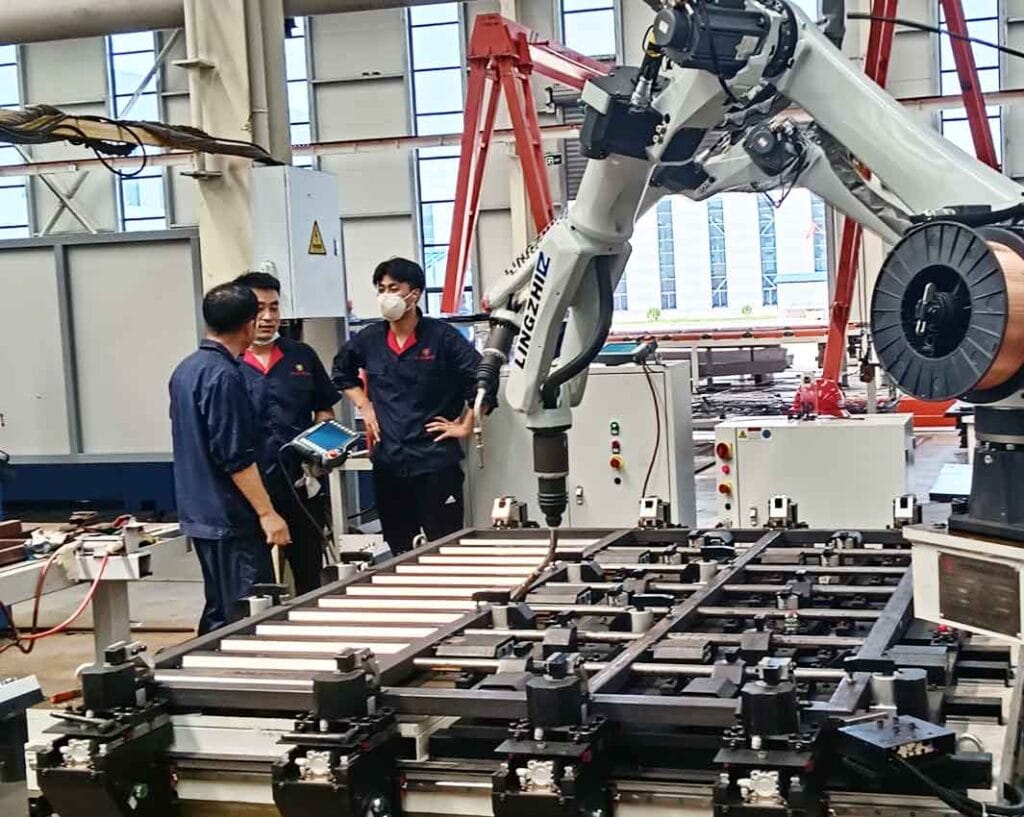
The phrase types of welding robots sounds simple, but choosing between them is rarely just a matter of selecting a robot arm. Different welding tasks place very different demands on reach, payload, speed, joint access, programming, workpiece positioning, sensing, and production flexibility.
A six-axis industrial robot may be ideal for complex three-dimensional joints, while a collaborative robot may be more practical for high-mix production and frequent changeovers. Spot welding applications require a different mechanical and process setup from arc welding, and large structures may need linear tracks, positioners, or coordinated external axes before the robot can reach every joint correctly.
For manufacturers evaluating the types of welding robots available today, the most useful question is not “Which robot is best?” but “Which robot architecture fits the workpiece, weld geometry, and production process?”
This guide explains the major types of welding robots, where each one performs well, what limitations should be considered, and how to match robot configuration to real manufacturing requirements.
Điều gì được tính là Robot hàn?
A welding robot is a programmable robotic system used to control welding motion and execute a defined welding process. In most industrial applications, the robot is only one element within a complete welding system that may also include the power source, torch, fixture, positioner, wire feeder, sensing equipment, safety devices, and cell controller.
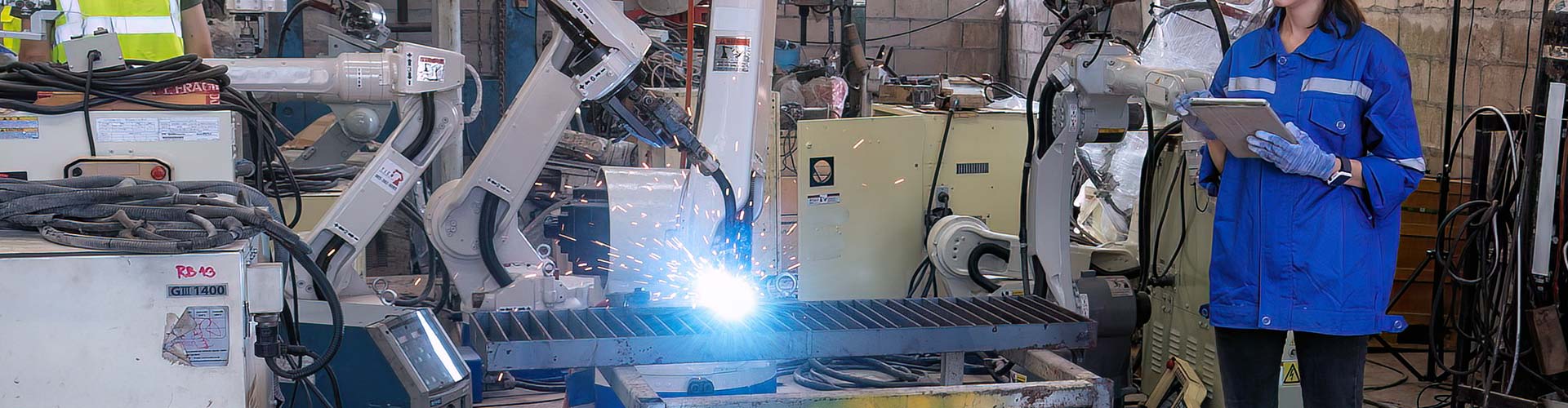
The most common platform is the robot công nghiệp, particularly articulated six-axis robots because their joint structure provides the flexibility needed to orient a welding torch around complex components.
However, the term welding robot can describe several different robot configurations.
Some are categorized by mechanical structure, such as articulated or gantry robots. Others are defined by how they interact with operators, such as collaborative welding robots. Another useful classification is based on welding application, such as arc welding, spot welding, or laser welding robots.
Understanding these categories helps prevent a common mistake: selecting the robot before understanding the welding process.
Các loại robot hàn chính
The major types of welding robots can be compared according to motion flexibility, typical application, workpiece scale, and production environment.
| Robot Type | Typical Strength | Common Application | Key Limitation |
|---|---|---|---|
| Six-axis articulated robot | Flexible torch orientation | Arc welding and complex assemblies | Requires careful path and collision planning |
| Robot hàn hợp tác | Flexible changeover and simpler teaching | High-mix and smaller-batch welding | Application-level safety still requires engineering |
| Robot hàn điểm | Handles welding gun and repeated spot patterns | Sheet-metal assemblies | Mainly suited to repetitive spot-weld tasks |
| Rail-mounted welding robot | Extended horizontal working range | Large frames and long structures | Requires coordinated track integration |
| Gantry welding robot | Covers large rectangular work areas | Large structural or panel welding | Less flexible around some three-dimensional joints |
| Dual-robot welding system | Simultaneous or coordinated welding | Large assemblies and high seam count | More complex synchronization and cell planning |
| Robot hàn laser | Precise tool positioning and path control | Precision robotic laser applications | Joint preparation and positioning can be demanding |
| Mobile or repositionable robot | Can serve multiple work areas | Flexible production environments | Repeatable setup becomes especially important |
The table shows why there is no single robot configuration that fits every welding operation. Robot selection should be connected directly to the geometry and production behavior of the workpiece.
Robot hàn khớp nối sáu trục
Six-axis articulated robots are among the most widely used types of welding robots because they provide a broad range of motion.
Their joint structure resembles a mechanical arm, allowing the robot to change position and orientation simultaneously. This is especially useful in arc welding, where the torch often needs to approach joints from different angles.
A six-axis robot can move around:
- khung
- dấu ngoặc
- machinery components
- structural assemblies
- xe tăng
- thành phần cong
- chế tạo nhiều mặt
The main advantage is orientation flexibility.
A robot may be able to reach the same physical point in several different wrist configurations. That flexibility allows engineers to choose a torch orientation that better suits the welding joint.
However, reach alone is not enough.
A robot that can physically reach a seam may still approach it from an unsuitable angle. Fixtures, nearby components, the welding torch, and cables can all reduce the usable working envelope.
This is why robot simulation should consider both position and orientation rather than simply checking maximum reach.
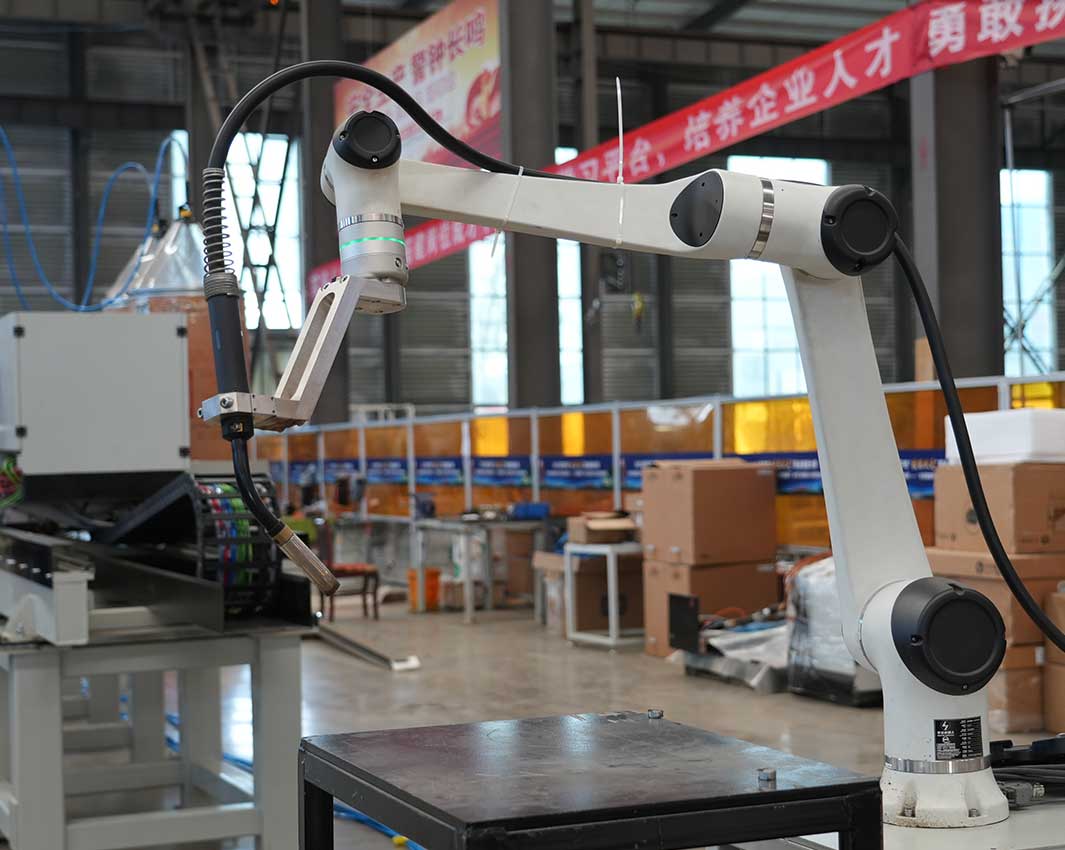
Robot hàn hợp tác
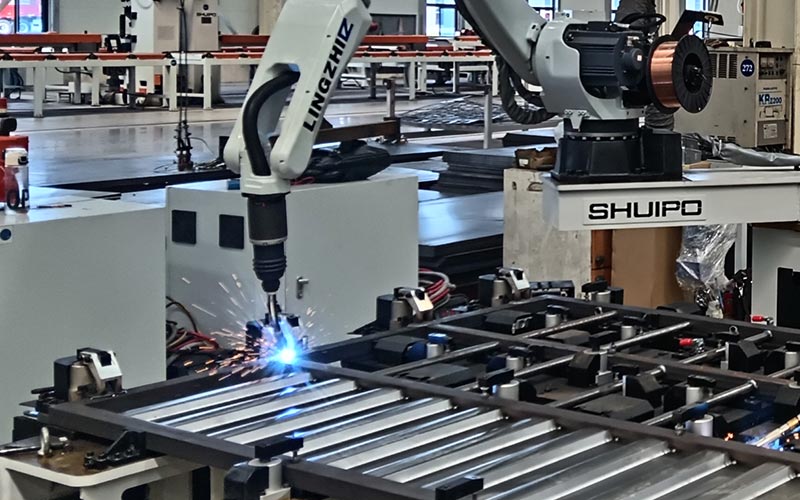
Collaborative robots have become increasingly important in welding automation because many manufacturers need more flexibility than a fixed high-volume cell provides.
A collaborative welding robot can be particularly useful where products change regularly and programming efficiency matters.
Typical advantages include easier teaching, compact integration, reusable programs, and faster adaptation to different workpieces.
They are often considered for:
- repeated fabrication tasks
- smaller product batches
- changing product families
- workshop-style production
- applications where manual and robotic welding coexist
The main attraction is not that the robot is physically smaller.
It is that the production system can often be reconfigured more easily.
For example, a collaborative robot mounted around a modular worktable may handle several component families by changing fixtures and selecting different welding programs.
However, collaborative does not mean safety requirements disappear.
The welding process introduces arc radiation, heat, fumes, spatter, and electrical hazards. The complete application therefore still requires proper protective measures.
Robot hàn điểm
Spot welding robots are designed around repeated resistance spot welding operations.
The robot carries a welding gun and positions it at specific locations on an assembly. Because the gun can be relatively heavy, robot payload and wrist capability become important selection factors.
Spot welding is highly repetitive, making it well suited to automation.
The process often involves:
- moving to a predefined point
- closing the welding gun
- executing the weld
- opening the gun
- moving to the next location
This repetitive sequence allows a well-designed robot program to maintain consistent weld locations across many assemblies.
Compared with arc welding, the torch-path challenge is different. The robot does not normally trace a continuous seam. Instead, it must position the welding tool accurately at many discrete locations.
For this reason, robot speed between weld points, access around the workpiece, welding gun geometry, and cable management become especially important.
Robot hàn gắn trên đường ray
Large components can exceed the practical working range of a stationary robot.
A rail-mounted system solves this by placing the robot on a linear axis.
Instead of remaining fixed at one base position, the robot can travel along the workpiece. This extends the effective welding range significantly.
Rail-mounted welding robots are useful for:
- long frames
- large structural components
- elongated machinery
- large fabricated assemblies
- production where seams are distributed over a wide area
The rail becomes another controlled axis within the robotic system.
This creates a larger workspace but also increases motion-planning complexity.
The robot program must account for both arm movement and rail position. Engineers need to decide whether the robot should reposition between welds or move along the rail while executing coordinated operations.
In large-scale welding, this additional axis can be the difference between forcing one robot to work at the edge of its reach and allowing it to operate inside a more stable working range.
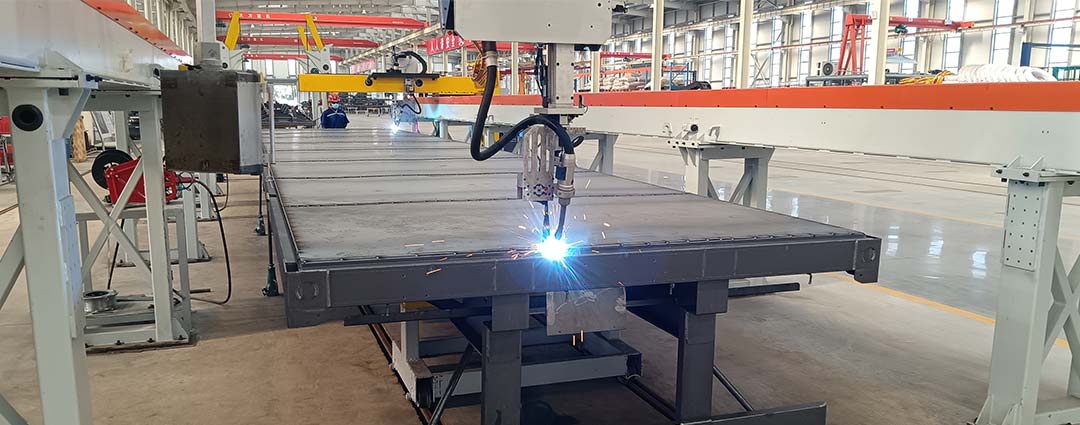
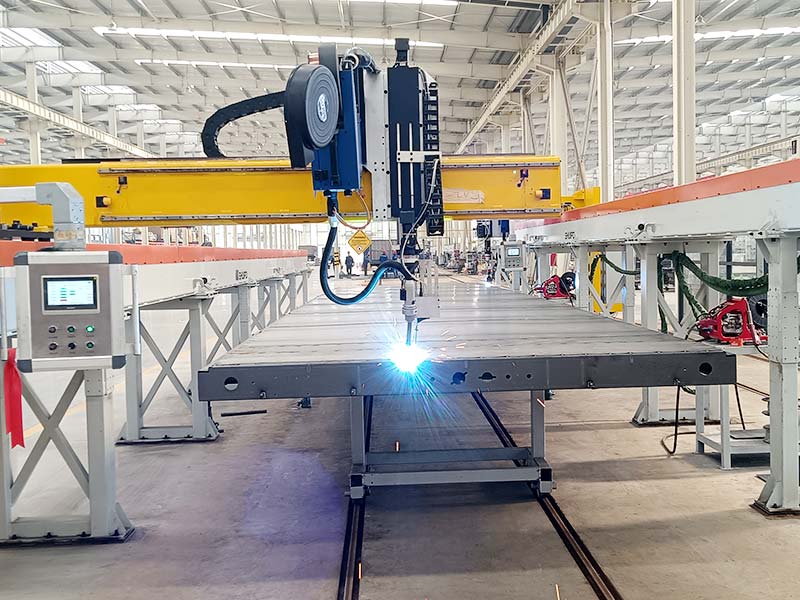
Gantry Hàn Robot
Gantry robots move along a frame or overhead structure, usually across large rectangular working areas.
They are especially useful when the workpiece itself is large and difficult to move.
A gantry system can position the welding head across long or wide structures without requiring the same articulated reach strategy used by a standard robot arm.
Typical applications may include:
- long seams
- large panels
- large structural assemblies
- repetitive linear welding
- fabrication where the workpiece remains stationary
The strength of a gantry system is workspace coverage.
Its limitation is that the movement structure may not provide the same three-dimensional orientation flexibility as a six-axis articulated robot unless additional axes are integrated.
For relatively predictable weld geometry, this can be an advantage because the system remains mechanically structured around a defined process.
For irregular three-dimensional workpieces, an articulated robot may offer greater flexibility.
Hệ thống hàn Robot kép
Some large assemblies contain enough welds that a single robot creates an unnecessary production bottleneck.
Dual-robot systems allow two robots to operate within the same production cell.
They may weld separate areas of the component simultaneously or perform different stages of the welding process in sequence.
This can be useful when:
- the workpiece contains many seams
- opposite sides need welding
- production balance requires parallel operations
- large structures contain clearly separated working zones
The engineering challenge is coordination.
The two robots must operate without collisions, while the fixture and workpiece positioner must support both working areas.
If the robots weld simultaneously, engineers also need to consider whether heat input and welding sequence influence distortion.
A dual-robot system should therefore be selected because the process supports parallel work, not simply because two robots appear faster than one.
Robot hàn Laser
Laser welding robots combine robotic motion with a laser-based welding process.
The robot controls the position and orientation of the laser welding head along a programmed path.
Compared with many arc welding applications, robotic laser welding may place particularly strong demands on:
- joint preparation
- component alignment
- path accuracy
- workpiece location
- optical access
The narrow interaction zone can make the process highly sensitive to real seam location.
As a result, sensing, vision, and precise fixtures can become important parts of the system.
Laser welding robots can be useful where precise automated motion and controlled seam geometry are required, but the decision should always follow process validation.
The existence of a robot does not remove the need to maintain suitable joint conditions.
Robot hàn Với Bộ định vị bên ngoài
Although positioners are not a separate robot type, they fundamentally change how a welding robot can operate.
A robot may struggle to maintain an appropriate torch angle if the workpiece remains fixed.
A positioner solves this by rotating or tilting the component.
This can transform a difficult welding path into a much simpler one.
For example, rather than forcing the robot wrist to rotate around a large cylindrical component, a positioner may rotate the workpiece while the robot remains in a stable welding posture.
Modern hệ thống hàn robot often combine robot motion with positioners, sensing, and workpiece fixtures so that the weld is presented to the robot in a more controllable orientation.
The best system therefore does not always have the robot perform all the movement.
Sometimes moving the workpiece produces a more stable process.
Robot hàn nào tốt nhất cho sản xuất hỗn hợp cao?
High-mix production creates one of the most difficult robot-selection decisions.
When components change frequently, maximum robot speed may be less important than programming flexibility and changeover efficiency.
A collaborative welding robot can be attractive because of easier teaching and a flexible workcell structure.
However, a conventional six-axis industrial robot can also handle high-mix production when paired with:
- offline programming
- reusable programs
- flexible fixtures
- seam sensing
- vision
- automated path generation
The real question is how structured the product variation is.
If every component is completely different, automation becomes difficult regardless of robot type.
If several product families share similar joint geometry, fixture datums, and welding procedures, the system can be designed around those common characteristics.
High-mix robotic welding therefore depends as much on production organization as on robot hardware.
Robot hàn nào tốt nhất cho cấu trúc lớn?
Large structures create a different set of priorities.
The robot may need to cover a working area far larger than its normal reach.
In this situation, possible solutions include:
- rail-mounted robots
- gantry systems
- large articulated robots
- repositionable robots
- dual-robot systems
- coordinated workpiece positioners
The decision depends on whether the structure can move.
If the workpiece is very large and difficult to reposition, moving the robot may be more practical.
If the workpiece can rotate safely, a positioner may simplify access significantly.
Joint distribution also matters.
A long frame with welds distributed along its entire length may benefit from a rail-mounted robot. A compact but three-dimensional structure may still be better suited to a fixed six-axis robot with a positioner.
The physical size of the component is therefore only one selection factor.
Phù hợp Robot Reach để truy cập ngọn đuốc thực s
Robot manufacturers normally specify maximum reach, but the useful welding range is more complicated.
A welding torch has length.
Fixtures occupy space.
Cables need routing.
The robot wrist needs room to rotate.
These factors reduce the practical workspace.
A common selection mistake is choosing a robot because the seam falls inside its published maximum reach.
The robot may reach the joint while being unable to maintain the required torch angle.
A better evaluation uses real workpiece geometry and realistic fixtures.
Simulation should examine:
- torch position
- tool orientation
- robot joint angles
- giải phóng mặt bằng cáp
- nhiễu vật cố định
- vị trí phôi
- external-axis movement
This provides a much more accurate picture of whether the robot can complete the welding task reliably.
Yêu cầu về tải trọng đối với robot hàn
Payload is often associated with material-handling robots, but it also matters in welding.
The robot may need to carry:
- hàn ngọn đuốc
- cảm biến va chạm
- wire feeding components
- cảm biến đường may
- laser sensor
- cable package
- other tool-mounted devices
The total tool weight must remain within the robot’s working capacity.
However, simply staying below the maximum payload is not enough.
Tool center of gravity and wrist moment also influence robot performance.
A long welding torch creates different mechanical loading from a compact tool of the same weight.
This becomes especially important when additional sensors are mounted near the torch.
Robot selection should therefore consider the complete welding tool assembly rather than only the torch itself.
Cảm biến thay đổi việc lựa chọn robot như thế nào
Sensing technology is expanding the range of work that different types of welding robots can handle.
A traditional fixed-path robot assumes the seam appears where the program expects it.
A sensor-equipped system can gather information about the actual workpiece.
This may allow the system to identify:
- seam position
- workpiece orientation
- joint geometry
- part presence
- dimensional variation
This flexibility is particularly important for fabricated components because real workpieces often differ slightly from nominal digital geometry.
When sensing is available, manufacturers may be able to automate applications that would otherwise require extremely tight fixture repeatability.
However, sensing does not make robot selection irrelevant.
The robot still needs sufficient reach, orientation flexibility, payload, and working clearance to follow the corrected path.
Sensors improve information.
They do not change the physical limits of the robot.
Loại Robot Nên Phù Hợp Với Quá Trình Hàn
Different welding processes create different demands on the robot.
Arc welding often requires smooth continuous motion along seams.
Spot welding requires repeated accurate positioning of a heavier welding tool.
Laser welding can require highly controlled path alignment.
Robotic TIG welding may place strong emphasis on torch-to-work distance and precise movement.
The robot should therefore be evaluated as part of the welding process.
A high-speed robot that cannot maintain appropriate torch orientation is not a good welding solution.
A highly flexible robot may also be unnecessary for a simple repetitive linear seam.
The most effective automation design matches mechanical capability to process requirements rather than choosing the most advanced robot available.
Những Sai Lầm Thường Gặp Khi Lựa Chọn Trong Số Các Loại Robot Hàn
One common mistake is selecting robot reach before the cell layout is understood.
Another is focusing on robot speed while ignoring loading, fixturing, and workpiece positioning.
Manufacturers may also underestimate product variation.
A robot programmed around one ideal component may struggle when normal production parts contain joint shifts or assembly differences.
Another mistake is assuming that collaborative robots require no application-specific safety engineering.
Welding hazards remain even when the robot itself supports collaborative operation.
Finally, some projects select a robot based only on current production.
If product families are likely to change, future fixture requirements, sensing needs, external axes, and programming flexibility should be considered before the cell design is finalized.
The robot should support the manufacturing strategy rather than restrict it.
Một khung lựa chọn thực tế
Before comparing different types of welding robots, manufacturers can evaluate the application using six basic questions.
First, what does the workpiece look like?
Record its dimensions, weight, joint locations, and geometry.
Second, how much variation exists?
Measure actual production components rather than relying only on drawings.
Third, how does the torch need to approach each weld?
This determines orientation requirements.
Fourth, can the workpiece move?
If a positioner can rotate the part, the robot may require less reach and fewer difficult wrist movements.
Fifth, how often will products change?
Frequent variation increases the importance of flexible programming, fixtures, and sensing.
Sixth, how will the entire cell operate?
Loading, clamping, welding, repositioning, and unloading should be evaluated as one process.
These questions usually narrow the robot choice much more effectively than comparing specifications in isolation.
Tương lai của việc lựa chọn robot hàn
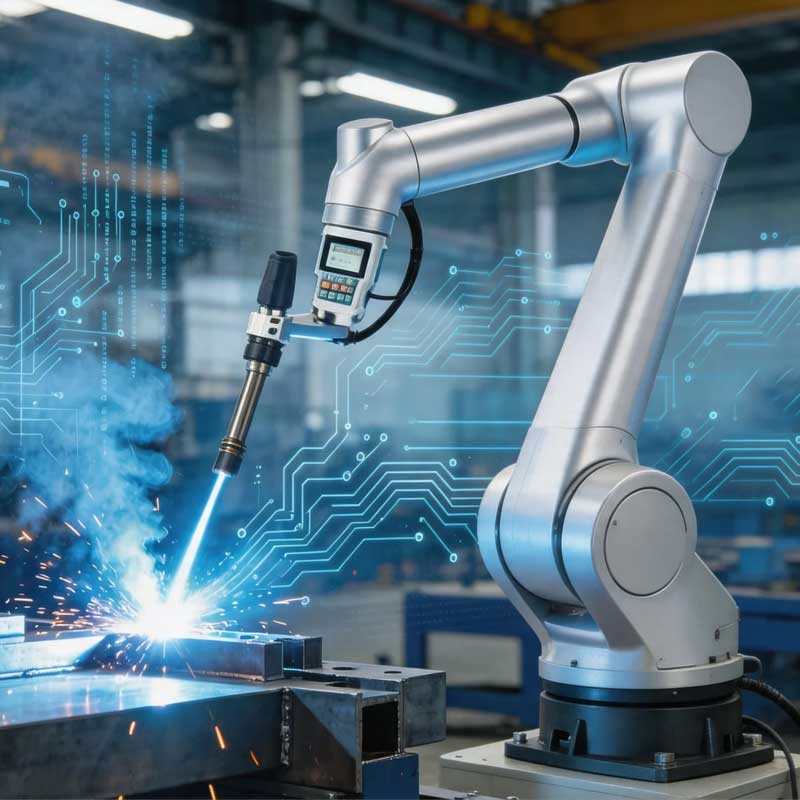
The boundaries between different types of welding robots are becoming less rigid.
Industrial robots are gaining easier programming tools.
Collaborative robots are being integrated with more advanced welding equipment.
Vision and seam sensing are expanding the flexibility of both platforms.
Rail systems and positioners are giving standard robots much larger effective working areas.
As these technologies develop, robot selection is shifting away from a simple hardware comparison.
The more important question is becoming:
How should the robot, sensing system, fixture, positioner, welding equipment, and software work together around the actual component?
That systems approach is especially important for high-mix manufacturing and large fabricated structures.
The strongest welding automation solution may not be based on one robot type alone. It may combine several motion technologies to create the working range and flexibility the application requires.
Kết luận
Understanding the different types of welding robots helps manufacturers avoid selecting automation based on robot specifications alone.
Six-axis articulated robots provide strong three-dimensional flexibility. Collaborative robots support frequent changeover and flexible production. Spot welding robots are optimized for repeated point-based welding, while rail-mounted and gantry systems extend automation across large structures. Dual-robot and laser welding systems address more specialized production requirements.
The best choice depends on workpiece geometry, joint type, reach, torch orientation, production variation, positioning strategy, and how frequently products change.
In many cases, the real solution is not simply choosing a different robot. It is combining the right robot with fixtures, sensing, positioners, and programming methods that make the complete welding process repeatable.
Câu hỏi thường gặp
Các loại robot hàn chính là gì?
Các loại phổ biến bao gồm robot khớp nối sáu trục, robot hàn cộng tác, robot hàn điểm, robot gắn trên đường ray, hệ thống giàn, robot hàn laser và tế bào robot kép. cấu hình tốt nhất phụ thuộc vào hình dạng khớp, kích thước phôi, quy trình hàn và tính linh hoạt trong sản xuất.
Robot hàn nào tốt nhất cho các mối hàn phức tạp?
Robot khớp nối sáu trục thường phù hợp với các mối hàn ba chiều phức tạp vì chúng mang lại sự linh hoạt định hướng mạnh mẽ. Tuy nhiên, bộ định vị và cảm biến cũng có thể được yêu cầu khi phôi có khả năng tiếp cận khó khăn, đường nối cong hoặc biến đổi kích thước bình thường.
Are collaborative robots suitable for welding?
Yes. Collaborative robots can support flexible welding applications, particularly where product variants change frequently. Their suitability still depends on reach, payload, welding process, fixture quality, joint variation, and a complete safety assessment of the welding workcell.
Which type of welding robot is best for large structures?
Large structures may use rail-mounted robots, gantry systems, large articulated robots, or coordinated positioners. The best choice depends on whether the workpiece can move, how welds are distributed, required torch angles, and the size of the effective working area.
How should I choose between different types of welding robots?
Start with the workpiece and welding process. Evaluate part dimensions, joint geometry, torch access, product variation, payload, robot reach, fixture strategy, positioner requirements, sensing needs, and expected product changes before selecting a robot configuration.
Cần trợ giúp Chọn Robot hàn phù hợp?
If you’re comparing different types of welding robots for changing workpieces, complex joints, large structures, or flexible production, the selection should begin with the actual welding process. Liên hệ SHUIPO to evaluate robot reach, workpiece positioning, sensing, fixtures, and automation requirements as one integrated production system.