
Table of Contents
Introduction
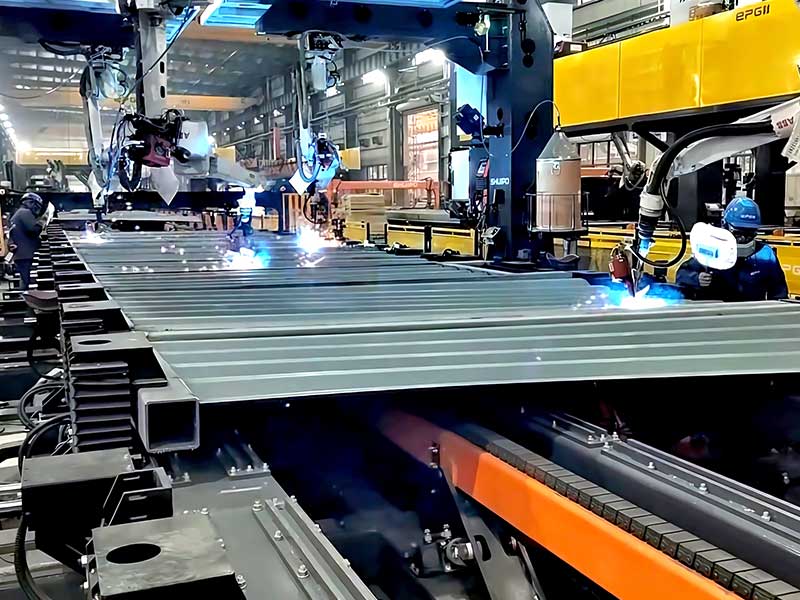
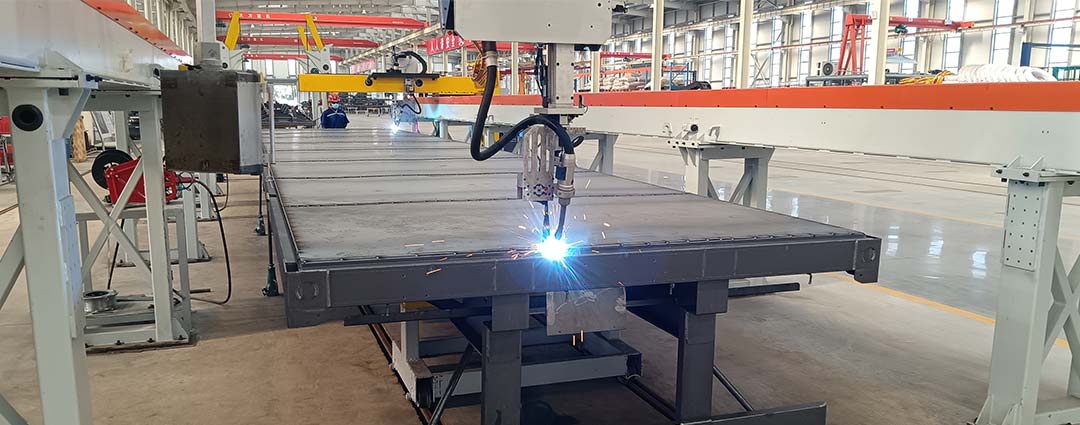
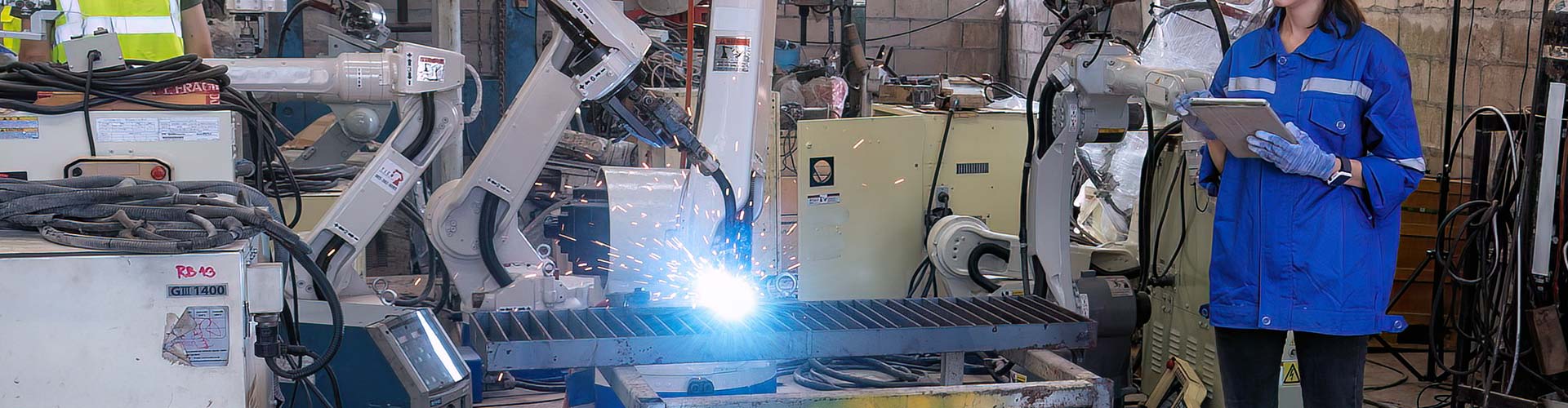
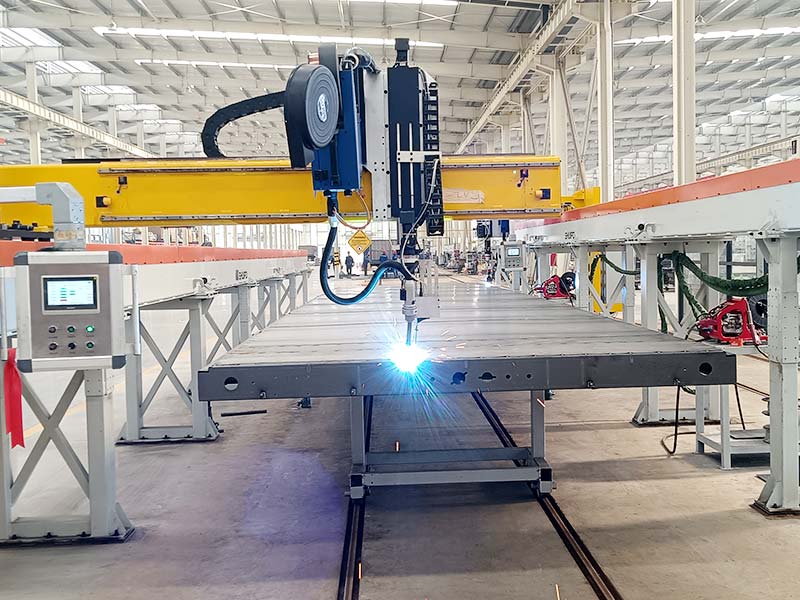
A welding automation production line is no longer simply a collection of welding robots placed beside a conveyor. In a well-designed system, workpiece loading, positioning, welding, sensing, handling, inspection, and production control are connected as one coordinated process.
That distinction matters because manufacturers often begin automation projects by focusing on the welding robot itself. Yet a fast and repeatable robot cannot create a stable production line if parts arrive inconsistently, fixtures locate workpieces differently, welding stations become unbalanced, or material handling interrupts the production rhythm.
The purpose of a welding automation production line is therefore broader than automating individual welds. It is to create a predictable manufacturing flow in which each operation supports the next one.
In 2026, this becomes especially important as welding automation increasingly incorporates flexible robot programming, seam sensing, machine vision, production data, and adaptive control. These technologies are expanding automation beyond highly repetitive parts and making it more practical for product families with controlled variation.
Understanding how these elements work together is the first step toward designing a production line that improves consistency without sacrificing the flexibility needed for changing manufacturing requirements.
What Is a Welding Automation Production Line?
A welding automation production line is an integrated manufacturing system that connects multiple welding and supporting operations into a controlled production sequence.
A conventional production line organizes manufacturing tasks so that workpieces move through a defined series of operations. A welding automation production line applies the same principle to welding-intensive manufacturing while incorporating robots, fixtures, workpiece positioners, sensing equipment, control systems, and material-handling devices.
Depending on the application, a line may contain:
- robotic welding stations
- automatic welding equipment
- loading and unloading stations
- fixtures and clamping systems
- workpiece positioners
- seam recognition systems
- visual sensors
- transfer devices
- inspection stations
- line controllers
- safety systems
The exact configuration depends on the workpiece.
A large fabricated structure may require robots on linear tracks and programmable positioners, while a smaller assembly may move through several compact robotic cells. Some components can travel continuously between stations, while others require indexed movement because each welding stage takes a different amount of time.
The production line should therefore be designed around the welding process rather than around a fixed equipment template.
How a Welding Automation Production Line Works
A typical welding automation production line begins before welding starts.
The workpiece must first arrive in a known condition. Components may need to be assembled, positioned, clamped, verified, or scanned before a robot can execute a reliable weld path.
Once the part is confirmed, the welding station performs its programmed operation. The workpiece may then move to another station for additional welding, repositioning, inspection, or another manufacturing step.
The sequence can be simplified into several stages:
| Production Stage | Main Function | Key SEO/Engineering Consideration |
|---|---|---|
| Loading | Introduces the workpiece to the line | Part orientation must be repeatable |
| Identification | Confirms part or product variant | Important in mixed production |
| Positioning | Establishes joint location | Fixture accuracy affects welding accuracy |
| Seam detection | Finds the real joint where required | Helps manage controlled variation |
| Welding | Executes validated welding process | Robot motion and process parameters must coordinate |
| Repositioning | Changes workpiece orientation | Improves access to complex joints |
| Transfer | Moves the part to the next station | Station timing must remain balanced |
| Inspection | Verifies process or weld condition | Can support process feedback |
| Unloading | Removes the completed workpiece | Must not become a production bottleneck |
The most important idea is that these stages are interconnected.
Improving one station without considering the rest of the line can move the bottleneck somewhere else rather than improving the complete process.
Why Production-Line Balance Matters
A welding automation production line operates effectively only when its stations work within a reasonably balanced production rhythm.
Imagine one robotic welding station completing its task quickly while the next station requires significantly more time. Parts begin accumulating between operations, and the faster robot spends part of its cycle waiting.
Increasing the speed of the first robot would not solve the problem.
The line must therefore be analyzed as a complete sequence.
Engineers should compare:
- welding time
- fixture loading time
- workpiece transfer time
- repositioning time
- seam sensing time
- inspection time
- unloading time
The slowest recurring operation often determines the effective production rhythm.
A strong line design may divide welding operations differently between stations, use two robots where simultaneous work is practical, or move certain operations outside the main cycle.
The goal is not to make every machine move as quickly as possible. It is to create a stable flow in which each station contributes effectively to the complete process.
Robotic Welding Systems as the Core Production Unit
Robots are frequently the central welding element within an automated line, but their function should be considered together with the surrounding equipment.
A line built around robotic welding systems may combine robot motion with workpiece fixtures, positioners, seam sensing, and external axes so that the welding operation remains aligned with the actual component.
This becomes particularly important when products include:
- long structures
- multiple welding faces
- curved joints
- circumferential seams
- changing joint orientations
- repeated product variants
In these applications, a fixed robot alone may not provide sufficient working range.
A positioner can rotate the workpiece. A linear axis can move the robot along a long component. A seam sensor can identify where the actual joint differs slightly from the nominal programmed position.
The best welding station is therefore not necessarily the station containing the largest number of robots.
It is the station where robot motion, workpiece movement, sensing, and welding requirements are coordinated around the real geometry of the product.
Fixture Design Determines Line Repeatability
Fixtures are among the most important components in a welding automation production line because they establish the physical relationship between the workpiece and the automated equipment.
A robot may repeat its programmed movement accurately, but that movement only aligns with the joint when the workpiece is also located consistently.
Fixture design should therefore address several requirements at the same time.
The part must be located using reliable reference surfaces. Clamping should prevent unwanted movement. The fixture must allow the welding torch to reach required joints without interference. Loading and unloading should remain practical, and the fixture should account for thermal behavior during welding.
Poor fixture design can create several problems.
A clamp may block the torch. A locating point may wear over time. A workpiece may be held securely but in a slightly different position each cycle. Excessive restraint may also influence how the part responds to welding heat.
For this reason, fixtures should be treated as part of the welding process rather than as simple work-holding accessories.
Material Flow Should Be Designed Around Welding
Material movement is another major factor in production-line performance.
Workpieces may move between stations using conveyors, transfer devices, AGVs, powered carts, indexing systems, or other handling equipment.
The correct choice depends on the component.
Small repeatable assemblies may move easily through a fixed conveyor arrangement. Large structures may require more flexible handling because their dimensions or orientations vary.
Material flow should answer several practical questions:
How does the part enter the welding station?
How is its orientation controlled?
Does it require turning before the next process?
Can the next station receive the workpiece immediately?
What happens when one station temporarily stops?
A production line that ignores these questions may contain highly capable welding equipment while still experiencing frequent interruptions.
Material flow should therefore be designed at the same time as the welding process.
Seam Sensing Makes Automation More Flexible
Traditional welding automation performs best when the joint appears exactly where the robot expects it.
Real fabricated components often contain normal dimensional variation.
Cutting, forming, assembly, tack welding, clamping, and thermal effects can all influence joint position before final welding begins.
A seam sensing system can help identify these differences.
Depending on the application, sensing may occur before welding begins or while welding is taking place. The resulting data can allow the robotic system to correct its path within predefined operating limits.
This becomes especially valuable when the welding automation production line handles product families rather than one completely identical part.
The objective is not to allow unlimited variation.
A better engineering strategy is:
control the variation that can reasonably be controlled through manufacturing and fixtures, then use sensing to manage the remaining predictable differences.
That approach provides greater flexibility without sacrificing process stability.
Machine Vision and Part Recognition
A flexible production line must know what is entering each station.
If different workpiece variants use the same automation system, the control system must identify the correct program, fixture configuration, welding sequence, or robot path.
Machine vision can support this process by identifying workpiece features or determining part orientation.
In more advanced applications, three-dimensional sensing can provide geometric information that supports seam location and path generation.
This capability changes how manufacturers can approach mixed production.
Traditional automation assumes that the environment remains fixed.
More flexible automation allows the system to gather information about the actual component before performing the task.
However, visual sensing works best when it solves a clearly defined problem.
Adding a camera does not automatically make a line intelligent. Engineers must determine what information is required, how accurately it needs to be measured, and what action the system should take when a difference is detected.
High-Mix Production Changes Line Design
A welding automation production line does not always produce one identical component.
Many manufacturers work with product families that share similar structures but differ in dimensions, joint positions, or optional features.
This creates a different automation challenge.
Instead of designing a line around one fixed component, engineers can identify what remains consistent across the product family.
For example, multiple products may share:
- similar joint types
- common reference points
- similar fixture locations
- repeated welding procedures
- comparable material thicknesses
- similar process sequences
The automation system can then be designed around those common characteristics.
Product-specific information may be handled through stored programs, adjustable fixtures, sensing, or parameterized robot paths.
This is one reason flexible welding automation increasingly focuses on structured variation rather than perfect part repetition.
If variation can be described, measured, and controlled, it is much easier to automate.
Workpiece Positioners Expand Welding Capability
A welding robot does not need to create every movement itself.
In many production lines, rotating or tilting the workpiece creates a better welding condition than forcing the robot into a difficult orientation.
Positioners can:
- rotate cylindrical workpieces
- tilt large assemblies
- index components between welding faces
- support circumferential welding
- improve torch access
- reduce extreme robot wrist positions
Coordinated systems can allow the robot and positioner to move simultaneously.
This becomes especially useful for curved seams and large three-dimensional workpieces.
Positioners can also improve consistency between stations because the same workpiece orientation can be reproduced automatically rather than relying on repeated manual adjustment.
The selection of a positioner should therefore be based on joint accessibility and welding orientation, not simply component weight.
When Multiple Robots Improve the Line
Some welding automation production line applications benefit from multiple robots operating at the same station.
This can be effective when a large workpiece contains clearly separated welding areas or when simultaneous operations can reduce station imbalance.
However, adding another robot also introduces additional engineering requirements.
The system must manage:
- collision zones
- coordinated motion
- welding sequence
- fixture access
- cable routing
- heat distribution
- shared workspaces
Two robots do not automatically make a station twice as effective.
If both robots frequently wait for the same workpiece movement or interfere with one another’s working range, the additional equipment may not improve the line significantly.
Multi-robot stations work best when tasks can be divided logically and each robot has a clearly defined role within the process.
Production Data Is Becoming More Important
Modern welding automation production line design increasingly treats process data as part of the manufacturing system.
Robots and controllers already generate information about:
- cycle completion
- program selection
- operating status
- welding sequence
- equipment conditions
- alarms
- production interruptions
When this information is organized correctly, manufacturers can identify patterns that are difficult to see through observation alone.
For example, a repeated stoppage at one station may indicate a fixture problem rather than a robot problem. Variation in production time may reveal inconsistent loading. Frequent path corrections may indicate that an upstream fabrication process requires attention.
The purpose of collecting data should therefore be practical.
More data is not automatically better.
The useful question is:
What information helps engineers understand whether the welding process and production flow remain within expected conditions?
Inspection Should Connect With the Welding Process
Inspection is often treated as the final step after welding is completed.
In a more integrated automation line, inspection can support process control rather than only final acceptance.
Depending on the application, the system may verify:
- workpiece presence
- joint location
- weld position
- bead geometry
- production sequence
- completed operations
When inspection identifies a recurring deviation, engineers can trace the problem back to the production process.
For example, if joint position gradually changes across several components, the cause may be fixture wear or upstream dimensional variation.
This makes inspection more valuable than a simple pass/fail operation.
It becomes a source of information for maintaining line stability.
Safety Must Be Designed Across the Entire Line
A welding automation production line combines several types of industrial hazards.
Robots create moving machinery risks. Welding introduces arc radiation, heat, fumes, spatter, and electrical hazards. Transfer systems move heavy components between stations.
Safety engineering must therefore consider the complete line.
Protective measures can include:
- physical guarding
- interlocked access doors
- scanners
- light curtains
- emergency stops
- safe robot functions
- controlled operating modes
- extraction systems
- safe transfer zones
One important consideration is how people interact with the production line during normal operation.
Operators may load components, change fixtures, inspect welds, or perform maintenance.
These activities should be included in the safety concept from the beginning rather than added after the mechanical layout is complete.
Common Welding Automation Production Line Mistakes
One of the most common mistakes is automating an unstable process.
If workpieces already arrive with uncontrolled joint variation, automation may expose the problem rather than solve it.
Another mistake is optimizing individual robot stations without considering the complete production sequence.
A very fast welding station provides little benefit if transfer or positioning repeatedly stops the line.
Fixture design is also frequently underestimated.
A welding path can only remain repeatable when the workpiece location is repeatable.
Manufacturers may also add sensing without defining what variation the sensor is expected to manage.
Technology should solve a measured production problem rather than being added because it appears advanced.
Finally, line designs sometimes focus only on the current product.
If product dimensions or variants are likely to change, fixture flexibility, robot reach, sensing, and control architecture should be evaluated with future production in mind.
How to Evaluate a Welding Automation Production Line
A useful evaluation begins with the real manufacturing process rather than an equipment list.
Start by mapping the complete production sequence.
Identify:
- workpiece variants
- welding joints
- joint quantities
- welding sequence
- loading requirements
- fixture requirements
- positioning operations
- transfer operations
- expected part variation
- inspection requirements
Next, measure representative production components.
Do not rely only on nominal drawings.
Understanding real variation is essential when determining whether the line needs fixed programming, seam sensing, vision, adjustable fixtures, or other adaptive features.
Then examine station balance.
Determine how much time each operation requires and identify where waiting or material accumulation is likely to occur.
Finally, consider future production.
A welding automation production line is most effective when its architecture can support realistic changes in products without requiring the entire system to be redesigned.
2026 Trends in Welding Automation Production Lines
The direction of welding automation in 2026 is moving toward production lines that can work with more information about the actual manufacturing environment.
Several developments are particularly relevant.
AI-assisted vision is improving the ability of robotic systems to recognize parts and joint locations. Adaptive welding is allowing controlled path correction when real workpieces differ from nominal geometry. Digital models are increasingly supporting programming and commissioning, while production data is being used to identify repeated process variation.
Another important development is the growing focus on high-mix automation.
Instead of requiring completely identical components, newer welding systems are being designed around product families with predictable differences.
This changes the role of the production line.
Rather than being a rigid sequence dedicated to one part, it can become a configurable manufacturing platform built around common welding processes.
The most successful applications will still depend on good fixtures, stable welding procedures, controlled part variation, and clear production logic. Intelligent technology improves the line when those fundamentals are already understood.
Conclusion
A welding automation production line should be designed as one connected manufacturing process rather than a collection of independent welding machines.
Robots provide repeatable motion. Fixtures establish workpiece location. Positioners create suitable welding orientations. Sensors manage controlled variation. Material-handling systems connect stations, while line controls coordinate the overall sequence.
The strongest results come from balancing these elements around the real workpiece and production flow.
Manufacturers should therefore begin with process analysis: understand joint geometry, part variation, station timing, fixture requirements, material movement, and future product changes before determining the final equipment configuration.
As sensing, adaptive control, machine vision, and digital production tools continue to develop, welding automation production lines are becoming more flexible. But the fundamental principle remains unchanged: reliable automation begins with a process that can be understood, measured, and controlled.
FAQ
What is a welding automation production line?
A welding automation production line integrates robotic or automatic welding stations with fixtures, positioners, material handling, sensing, controls, and inspection. The objective is to create a coordinated manufacturing sequence rather than automate individual welds in isolation.
What equipment is used in a welding automation production line?
Typical equipment includes welding robots, power sources, fixtures, positioners, seam sensors, visual systems, transfer devices, controllers, safety equipment, and inspection stations. The exact configuration depends on workpiece geometry and production requirements.
Can a welding automation production line handle different products?
Yes, when product variation is structured. Stored programs, adjustable fixtures, machine vision, seam sensing, and parameterized robot paths can allow one line to handle multiple related products while maintaining controlled welding and positioning conditions.
Why is fixture design important in an automated welding line?
Fixtures establish the repeatable relationship between the workpiece and welding equipment. Poor positioning can shift the real joint away from the programmed path. Good fixtures also maintain torch access, appropriate clamping, efficient loading, and stable production.
How can sensing improve a welding automation production line?
Sensing can identify actual workpiece position or seam location when normal fabrication tolerances create controlled variation. The welding system can then adjust its path within defined limits, improving flexibility without relying completely on fixed nominal geometry.
Need Help Planning the Right Welding Automation Production Line?
If your production includes multiple welding stations, changing workpieces, complex positioning, seam variation, or automated material flow, the complete process should be evaluated before individual equipment is selected. A welding automation project consultation can assess joint geometry, fixtures, robotic stations, sensing, positioning, and line balance around your actual production requirements.